Deep Research · Ancient Engineering · Coastal History
Roman Harbor Engineering: How Ancient Breakwaters Outlasted Empires
Most people think Roman engineering peaked with roads. It didn’t. The real breakthrough happened underwater — and it’s why certain breakwaters from 22 BCE are structurally intact today while seawalls built in the 1970s are already failing.
I’ve been researching ancient construction for a while, and I keep running into the same gap in how this story gets told. Everyone cites Roman concrete. Fewer people talk about what the Romans actually built with it — specifically, how they put harbor structures into open ocean without modern equipment and produced breakwaters that are still sitting on the sea floor intact today. That’s the part I want to explain here, because it’s technically more interesting than the concrete alone.
Section 01 — Starting Point
It Wasn’t the Roads
If you ask someone what the Romans built best, roads come up almost immediately. Sometimes aqueducts. Occasionally the Pantheon. Roads get the attention because they’re everywhere, they’re visible, and there’s something satisfying about a straight line cutting across a continent for two thousand years.
But roads are a relatively manageable engineering problem. You survey a route. You dig. You lay materials in layers. You drain the edges. The physics stay in one place. The challenges are mostly organizational — enough people, enough stone, enough supervision across enough distance.
Harbors are a different category of problem entirely.
A harbor structure built in the open ocean has to survive something roads never face: continuous dynamic force. Waves don’t arrive once and go away. They arrive ten thousand times a day, every single day, for centuries. Storm swells stack on top of tidal surges. Longshore currents push sediment into basins. Salt works its way into any material that isn’t specifically built to handle it. And the entire structure sits submerged — no inspection, no maintenance, no repair — indefinitely.
The Roman Empire ran entirely on maritime trade. Grain from Egypt, marble from Greece, Spanish olive oil, North African timber — none of it arrived overland in any meaningful quantity. It all came by ship. Which means it all depended on harbors. Not rough anchorages, but functional, deep-water, protected harbors capable of handling dozens of vessels simultaneously, in all weather, year-round.
The Romans built dozens of them. And most of those structures are still physically present — not as decorative ruins, but as functioning masses of material holding their shape on the sea floor.
The real breakthrough in Roman harbor engineering wasn’t a single invention. It was a decision to treat the harbor as a coordinated system — material, geometry, and site location all working together — rather than three separate problems to solve independently. When all three aligned, the ocean itself helped reinforce the structure over time rather than destroy it. That’s the part that took modern science until 2017 to fully map.
I want to break down exactly how that system worked, because the pieces are individually impressive but the combination is what made the performance possible.
Section 02 — Primary Case Study
Caesarea Maritima: Built Where It Shouldn’t Exist
The clearest example of Roman harbor engineering taken to its logical extreme is Caesarea Maritima, on what is now the coast of Israel. I keep returning to this site because the location itself is the story.
There’s nothing there — no natural bay, no sheltering headlands, no offshore islands. The coastline is flat, completely exposed, and gets hit directly by dominant northwesterly winds that build wave energy across the open Mediterranean before arriving full-force at the shore. If you were looking at a map and had to identify the worst possible location for a major harbor in that entire region, Caesarea Maritima is a strong candidate.
And that’s exactly where, starting around 22 BCE, Roman engineers — commissioned by Herod the Great but working with Roman materials and Roman methods — built one of the most ambitious artificial harbors the ancient world had ever attempted.
“Notwithstanding the totally exposed position and open sea surrounding it, he so mastered the difficulties as to leave nothing to be desired by those using the port.”
Flavius Josephus — Jewish Antiquities, c. 93 CEJosephus was a historian, not an engineer, so it would be fair to read that as imperial praise. Except that modern underwater archaeology has essentially confirmed it. The breakwater foundations are still down there — concrete blocks in some cases the size of a small room, encrusted with two thousand years of marine growth but structurally intact. The harbor no longer functions, but the material that was supposed to hold hasn’t failed.
The structure included two converging breakwaters enclosing a protected anchorage estimated at roughly 100,000 square meters. The main southern breakwater extended well over a third of a mile into open water — built entirely offshore, on a site with zero natural shelter, using materials that had to be shipped in from Italy.
That last detail is the one that changes how I think about the whole project. The harbor at Caesarea required its own prior logistics operation just to begin construction. You needed ships, reliable navigation, and bulk storage capacity on-site before a single formwork frame could be lowered into the water. The construction project needed its own supply chain infrastructure before it could start. I’ll come back to this, because it reshapes how you understand what the Romans were actually organizing.
The construction took approximately twelve years. When it was finished, Josephus described a harbor rivaling the Piraeus of Athens in capacity. Based on the underwater survey data, that comparison appears to be roughly accurate rather than literary exaggeration.
Section 03 — Construction Method
How They Poured Concrete Underwater
This is the part that took modern engineers the longest to accept, and honestly, I understand the initial skepticism. When you first encounter it, it sounds wrong.
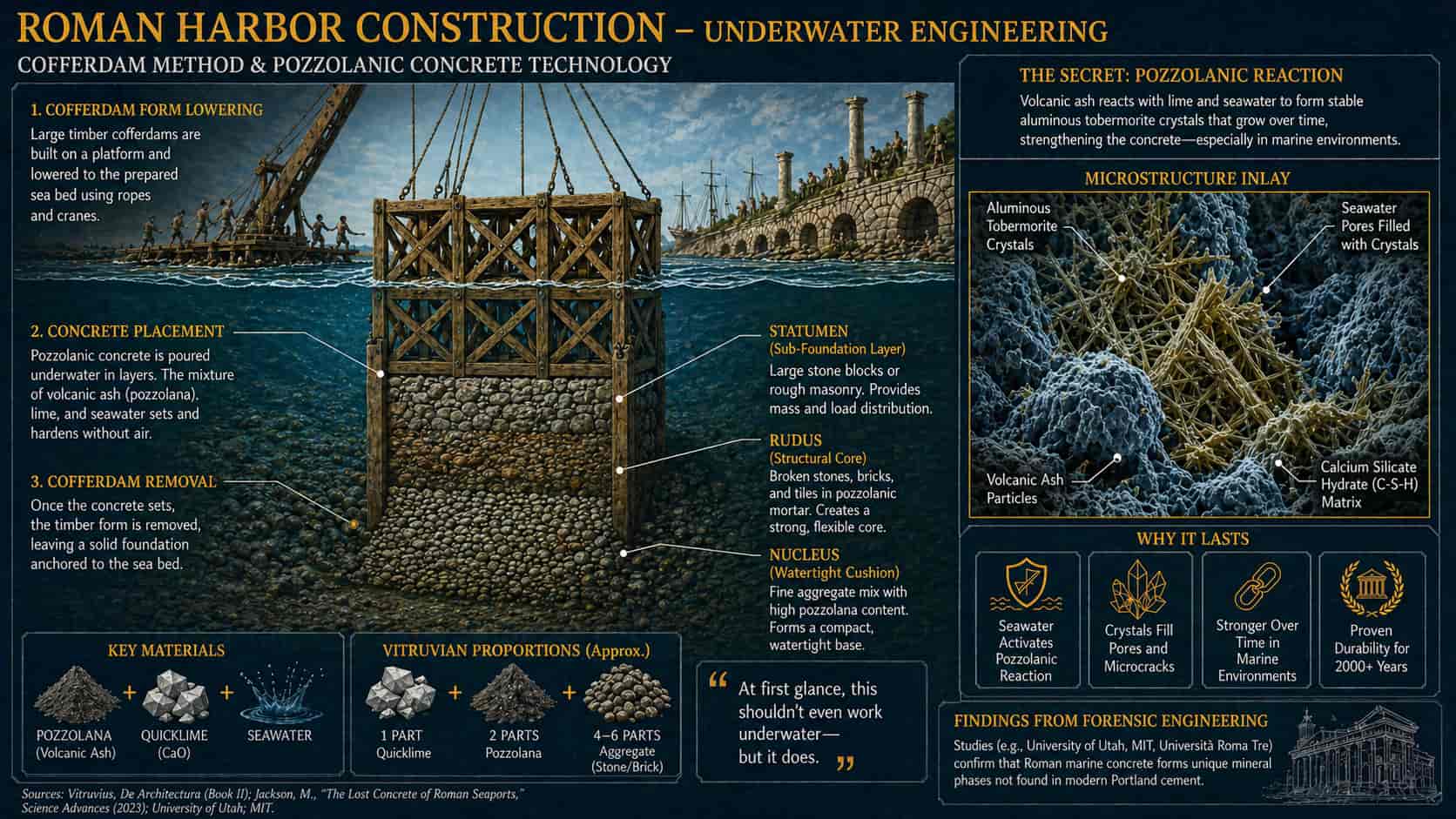
Roman workers built large hollow timber frames — called formwork or cofferdams — and lowered them to the sea floor at the intended breakwater location. Once positioned and anchored in place, workers on boats and rafts poured a wet concrete mixture directly into the submerged forms. Not down into a dry enclosed space. Into the ocean, with seawater present throughout the pour and the cure.
The concrete didn’t just survive being submerged during curing. Based on what the chemistry actually shows, it appears to have actively needed contact with seawater to complete its reaction correctly. The ocean wasn’t an obstacle the Romans had to work around. It was a component of the construction process.
I had to double-check this detail when I first encountered it, because every instinct about construction says that pouring concrete into saltwater should be catastrophic. If you pour modern Portland cement into seawater, it degrades. The salt attacks the calcium silicate hydrate matrix. Steel rebar corrodes and expands, fracturing the material from inside. The entire framework of modern marine construction is built around keeping seawater away from the structure’s interior.
Roman pozzolanic concrete works on an opposite logic. When seawater infiltrates the material, the minerals in the water trigger a series of crystallization reactions that produce new reinforcing structures inside the matrix — structures that strengthen the material rather than degrading it. In plain terms: the concrete kept hardening for years after it was poured, because the ocean was completing the chemical work that the initial mixing had started.
The 2017 paper by Jackson et al. in American Mineralogist used synchrotron X-ray analysis to map the interior of Roman harbor concrete samples from Caesarea and Italian port sites. They found tobermorite and phillipsite crystals growing within the concrete matrix — and crucially, the older the sample, the more densely those crystals had formed. Seawater exposure wasn’t neutral for this material. It was actively beneficial. The concrete was still, in a meaningful chemical sense, curing after two thousand years in the sea.
The layered structure of Roman harbor concrete also wasn’t random. The material was typically placed in distinct layers: a coarse rubble and aggregate base (statumen), a finer volcanic ash mortar layer above it, and a dense finishing surface (nucleus) at the top. Each layer had a specific structural role. The diagram at the top of this article shows how those layers interact in the cofferdam context. This wasn’t a homogeneous pour. It was a deliberately engineered composite structure.
Understanding this also helps explain something that puzzled historians for a long time: why Roman marine concrete structures have survived so much better than Roman structures built on land using broadly similar materials. The ocean, it turns out, was providing ongoing chemical reinforcement that no land-based structure ever received. The harbor structures weren’t surviving despite being in the sea. They were surviving partly because of it.
Section 04 — Material Science
The Chemistry They Understood by Feel
None of this was understood chemically by the people who built it. The Romans didn’t have a periodic table. They didn’t know what tobermorite was. They had no framework for understanding pH-triggered pozzolanic reactions or alumina-to-silica ratios. What they had was something that looks, in retrospect, more like rigorous empirical engineering than intuition: generations of accumulated observation about which specific materials produced reliable results and which ones didn’t.
The key ingredient was a volcanic ash called pulvis puteolanus — named after Puteoli, the Roman port near modern Naples. The ash came from the Campi Flegrei volcanic region, and its specific mineral composition was what triggered the tobermorite crystallization when mixed with quicklime and seawater. This material was what separated Roman marine construction from everything that came before it — and, for about fifteen centuries, from everything that came after.
Vitruvius documented this with notable specificity around 15 BCE. He didn’t explain why the ash worked. He specified that this particular ash, from this particular region, was required for marine construction, and that local substitutes produced inferior results. He was accurate on both counts. The mechanism simply wasn’t available to him to explain.
That part is worth pausing on. The Romans arrived at a genuinely sophisticated material solution through a methodology that looks — stripped of its ancient context — remarkably similar to modern engineering testing. Observe a result. Repeat the conditions. Refine the specification. Document the requirements. Apply the knowledge at scale. They were doing that, systematically, across a centuries-long institutional engineering culture. They just couldn’t explain the chemistry driving the results they were seeing.
The Supply Chain That Made It Possible
Here is the logistical detail I flagged earlier, and it genuinely reframes the scale of what Caesarea Maritima represents.
The harbor is in Israel. The ash is from near Naples. To build Caesarea, Roman engineers had to organize the movement of large quantities of highly specific volcanic material across a significant stretch of open Mediterranean water — before construction could begin. The harbor project required its own prior maritime logistics infrastructure just to exist.
I keep coming back to this because it’s easy to look at a finished harbor and see a construction project. What you’re actually looking at is a supply chain that funded and organized a ship fleet, moved bulk material reliably over hundreds of miles of open water, and maintained storage capacity at an exposed coastal site — all before the first timber frame was lowered into the sea. Roman roads show the same structural logic: the network required to build the infrastructure was itself a complex infrastructure problem that had to be solved first. The method built the method.
Many accounts describe Roman harbor concrete as using volcanic ash generically, implying that any pozzolanic material would produce the same results. The evidence suggests otherwise. The specific alumina-to-silica ratio and mineral grain morphology of Campi Flegrei ash appear to be what triggered the tobermorite crystallization at the rate and density observed in surviving harbor structures. When that supply chain collapsed after Rome’s fall, medieval builders who tried to replicate marine concrete using locally available volcanic materials consistently failed to produce the same performance. The formula was known. The ingredient appears to have been effectively irreplaceable with what was accessible in post-Roman Europe.
Section 05 — Structural Design
Shape Did Half the Work
This is the piece of the story I most commonly see underplayed, and I think it matters as much as the material chemistry. Even the best concrete fails if you put it in the wrong shape against the ocean. The Romans appear to have understood this through practice — and the breakwater geometry they used at Caesarea and other major harbor sites reflects a clear, functional logic that modern coastal engineers have independently arrived at through fluid dynamics analysis.
Breakwaters fail in two basic ways. The material degrades internally and loses structural cohesion. Or the wave force exceeds what the base can bear, and the structure shifts or erodes from underneath. Modern engineering has focused intensely on the first problem through material improvement. Roman harbor engineering addressed both simultaneously by treating shape and material as a unified solution.
Roman breakwaters consistently follow a curved or angled plan rather than running straight out from the shore. The seaward face is a sloping mass of rubble and concrete rather than a vertical wall. Both of these are doing specific structural work.
Vertical Face Walls
Wave energy reflects at near-full force. Concentrated stress at the base fractures material over repeated impact cycles.
Sloped Mass Breakwaters
Wave energy dissipates progressively across the slope. Stress distributes broadly — no single fracture point.
A curved plan causes waves arriving from different directions to reflect into each other rather than combining their energy against a single structural point. The reflected waves partially cancel each other out. A sloped face causes breaking waves to lose energy progressively as they run up the slope instead of hitting a vertical surface at full force and rebounding into the base at near-full energy.
In simple terms: the shape was doing structural work that the material alone couldn’t sustain over two thousand years of continuous impact. The concrete and the geometry were a joint solution, not separate ones.
Vitruvius also devoted significant attention to site selection before any material choice or geometry decision. He wrote about reading wind patterns, understanding seasonal currents, and using natural coastal features wherever they existed. The engineering objective was always to reduce the total wave force the structure would face — not to maximize the structure’s capacity to endure it. Build where the sea is doing some of the work for you. Orient the harbor mouth away from prevailing storm directions. Let natural coastal geometry carry part of the load.
Modern port siting frequently inverts this logic. Commercial geography determines where a harbor gets built, and engineering is applied afterward to manage whatever wave environment the site delivers. That approach works, but it produces structures with shorter design lives and higher maintenance costs than sites chosen with wave physics as the primary criterion. Romans built slowly and expensively, which made the upfront site analysis worth the time. That constraint, ironically, produced more efficient structures.
Section 06 — Material Comparison
Roman vs. Modern: The Real Numbers
I want to be careful here, because comparisons like this can tip quickly into oversimplification. Roman concrete isn’t better than modern concrete across the board. It has real limitations — slow curing, limited tensile strength, geographic material dependency. For most of what we build today, Portland cement is genuinely the right choice. But for static marine structures specifically, where curing speed is irrelevant and long-term seawater exposure is the defining performance condition, the comparison looks different.
// Roman Harbor Engineering vs. Modern Portland Cement Marine Construction
| Design Factor | Roman Harbor Engineering | Modern Portland Cement |
|---|---|---|
| Reaction to Seawater | Appears to strengthen — tobermorite & phillipsite crystals grow within matrix | Degrades over time — chloride attacks internal structure; rebar corrodes and expands |
| Observed Marine Lifespan | 500 – 2,000+ years (archaeological record) | 50 – 120 years (engineered design life) |
| Breakwater Face Geometry | Sloped rubble mound — progressive wave energy dispersal | Mixed; vertical caisson walls common in modern deep-water construction |
| Self-Repair Capability | Likely yes — crystal infill of micro-cracks observed in aged samples | No — cracks require active inspection, patching, or full replacement |
| Carbon Production Intensity | Lower — quicklime fired at approximately 900°C | Very high — Portland clinker at approximately 1,450°C; roughly 8% of global CO&sub2; |
| Tensile Reinforcement | None — mass geometry and crystal interlocking provide compression strength | Essential — steel rebar required for bending and tensile load resistance |
| Site Selection Driver | Wave physics and natural coastal geometry determined location first | Economic geography typically determines location; wave management engineered afterward |
| Curing Speed | Slow — months to full strength | Fast — days to usable structural strength |
That curing speed row matters for understanding why Roman methods weren’t simply adopted when Portland cement appeared in 1824. Modern Portland cement can be poured on a Monday and walked on by Wednesday. Roman pozzolanic concrete takes months. For the construction pace that modern economies require, that’s not a tradeoff — it’s a disqualification from most applications. But for a seawall or harbor breakwater that won’t be revisited for decades, speed of cure is close to irrelevant. The relevant variable is lifespan per ton of material produced — and on that metric, the Roman system isn’t competitive. It’s in a different category.
Section 07 — Historical Record
Timeline: Harbor Engineering Through History
c. 700 BCE
Phoenician Precedents
Phoenician traders build working harbors at Tyre and Carthage using rubble mound breakwaters — large stones piled in water to create shelter. Effective within limits but entirely dependent on stone mass. No chemical reinforcement mechanism.
c. 150 BCE
Roman Experiments at Puteoli
Roman engineers at the Bay of Naples port of Puteoli begin using locally abundant pozzolana ash in marine concrete mixes. The material behaves differently from anything previously tested — structures that should degrade in seawater don’t. The observation is documented and the method spreads through the Roman engineering network.
22 BCE – 10 BCE
Caesarea Maritima
Roman engineers ship pozzolana from Italy to the coast of modern Israel. Over roughly twelve years, they construct two converging breakwaters on a fully exposed coastline with no natural shelter. The harbor upon completion handles commercial traffic at a scale comparable to the largest Greek ports. Josephus documents the achievement in detail.
42 CE – 113 CE
Portus — Rome’s Grain Terminal
Emperor Claudius begins Portus near Ostia, Rome’s primary grain import point. The hexagonal inner basin, finished under Trajan, becomes the design reference for enclosed basin harbors throughout the empire. At peak operation, Portus handles an estimated 400 vessels simultaneously.
476 CE
The Supply Chain Collapses
The Western Empire’s fall severs the maritime trade networks that moved pozzolana from Campi Flegrei to construction sites across the Mediterranean. Without the ash, the marine concrete chemistry can’t be replicated. Medieval harbor builders default to rubble mound construction — effective in sheltered water, inadequate against open-sea wave exposure.
1824 CE
Portland Cement Patent
Joseph Aspdin patents Portland cement. Fast-curing, consistent, and compatible with steel rebar, it enables industrial-scale construction and makes Roman-style methods seem obsolete. The inherent lifespan limitation in saltwater environments isn’t seriously questioned for over a century.
2009 – 2017 CE
The Crystal Structure Is Mapped
UC Berkeley researchers led by Marie Jackson analyze Roman marine concrete samples from Caesarea and Italian harbor sites using synchrotron X-ray analysis. Tobermorite and phillipsite crystal growth within aged samples is documented and mapped. The evidence confirms that seawater exposure was causing ongoing mineral reinforcement, not degradation. What Pliny described empirically nearly 2,000 years earlier is validated by materials chemistry.
2023 CE
The Hot Mixing Mechanism Confirmed
MIT and Harvard researchers publish in Science Advances, identifying the hot mixing process — reactive quicklime rather than pre-slaked lime — as the mechanism that distributed reactive lime clasts throughout the material and enabled its self-healing behavior when cracked. The white chunks previously dismissed as poor mixing turn out to be the critical functional component.
There’s a gap in that timeline that I find genuinely strange to think about. From roughly 476 CE to 2009 CE — fifteen centuries — the specific reason why Roman harbor structures outlasted everything built after them was essentially unknown to the engineers trying to build coastal infrastructure. The structures were visible. In some places, medieval builders constructed new harbors directly on top of Roman foundations because the Roman material was still solid enough to serve as a base. The evidence was physically present. But the mechanism — the reason the ocean was reinforcing rather than destroying the material — wasn’t mapped until 2009, and wasn’t fully explained until 2023.
That’s not a failure of intelligence across fifteen centuries of European engineering. It’s a failure of instruments. The analytical tools required to see tobermorite crystal formation inside a concrete matrix at the relevant scale simply didn’t exist until recently. Sometimes a mystery persists for that long not because no one was looking, but because no one had the equipment to see what they were looking at.
Section 08 — Modern Implications
Why Roman Harbor Engineering Still Outperforms Modern Design
Before I get into this section, I want to be clear about something. Roman harbor engineering didn’t outperform modern construction across every dimension. It was slow, geographically constrained in its material requirements, and couldn’t produce structures with high tensile strength. You couldn’t build a suspension bridge with it or a skyscraper frame. For the vast majority of what modern construction requires, Portland cement with steel reinforcement is the right answer.
But for one specific and increasingly urgent application — static marine structures designed to last in a saltwater environment — the Roman approach appears to have produced results that modern methods haven’t replicated. And that specific application is becoming more important now than it has been at any point since Rome fell.
Sea levels are rising. Coastal cities from Miami to Jakarta are facing the reality that their existing seawalls and harbor infrastructure — almost entirely built with Portland cement — will reach the end of their engineered design lives within the next 30 to 60 years. That deadline lands at exactly the moment when those structures need to be larger, stronger, and more durable than anything previously built.
There’s a detail in this situation that I find genuinely difficult to reason around. The primary tool for protecting coastlines from climate-driven sea level rise — Portland cement — is itself a significant contributor to the CO&sub2; emissions driving the sea level rise those structures are meant to resist. Manufacturing Portland cement clinker requires limestone heated to roughly 1,450°C. That process contributes an estimated 8% of global CO&sub2; emissions annually. Building more seawalls to address climate change using Portland cement accelerates the problem those seawalls exist to manage. It’s an arithmetic loop with no internal resolution.
Roman quicklime was fired at approximately 900°C. The lower temperature means less fuel, less CO&sub2;, and a substantially smaller carbon footprint per ton of material produced. For a structure that also lasts ten to twenty times longer, the lifecycle comparison isn’t marginal. It’s substantial.
Research teams at UC Berkeley and other institutions have tested the tobermorite crystal reaction using volcanic ash from sources outside the Campi Flegrei region — including deposits in the American Pacific Northwest and Iceland. Early results suggest the chemistry may not be permanently locked to Italian pozzolana. If those results hold up through broader material testing, it would mean Roman-style pozzolanic concrete could be manufactured regionally rather than requiring the long-distance supply chains that both built and ultimately destroyed Roman harbor capacity. Several governments are now funding this research specifically because of the coastal infrastructure and climate-carbon paradox it addresses.
Modern coastal engineers studying ancient material systems that still challenge modern engineering assumptions have already begun revising some fundamental assumptions about marine construction. The shift isn’t theoretical anymore. There are active programs attempting to replicate Roman pozzolanic concrete for practical coastal applications, funded by national infrastructure agencies dealing with the climate infrastructure problem in real time.
The structural decisions behind ancient infrastructure that outlasted the civilizations that built it were rarely products of accident. What the archaeological record consistently points to is a construction culture that prioritized observational rigor, material specificity, and long design horizons over construction speed. Roman harbor engineering is the clearest surviving demonstration of what that combination produced — and it’s relevant now for the same reason it was relevant in 22 BCE: the sea operates according to the same physics it always has, and a structure built to work with seawater chemistry rather than against it will consistently outlast one that isn’t.
Section 09 — Frequently Asked Questions
FAQ: Roman Harbor Engineering
The questions I see most often about this topic, answered with what the current evidence actually shows.
How did Romans build harbor foundations underwater?
They used large hollow timber frames — cofferdams — lowered to the sea floor at the intended breakwater location. Workers on boats poured a wet mixture of volcanic ash, quicklime, and seawater directly into those submerged forms. The pozzolanic chemistry of the Campi Flegrei ash allowed the concrete to harden completely underwater — something modern Portland cement cannot do without significant chemical additives, because saltwater degrades Portland cement over time rather than assisting its cure.
What made Roman harbor breakwaters so durable?
Three things worked together. Pozzolanic concrete that grew reinforcing tobermorite and phillipsite crystals when exposed to seawater, making the material progressively more dense over time. Sloped and curved breakwater geometry that dispersed wave energy across a broad surface rather than concentrating it at a single impact line. Site selection based on wind and current analysis that minimized total wave loading on the structure before the first stone was placed. Remove any one of those three elements and the performance degrades significantly — the system only worked because all three were present.
What was the most ambitious Roman harbor ever built?
Caesarea Maritima is generally considered the most ambitious because of where it was built — a completely exposed coastline in modern Israel with no natural shelter. Two converging breakwaters enclosed a protected anchorage of roughly 100,000 square meters, with the main southern breakwater extending over a third of a mile into open water. Comparable offshore artificial construction wasn’t attempted again at that scale until the modern era.
Why did Roman harbor engineering knowledge disappear?
The specific volcanic ash required — pulvis puteolanus from Campi Flegrei near Pozzuoli — was distributed through maritime trade networks that collapsed with the Western Roman Empire. Medieval builders were aware of Roman construction methods in general terms, but they lacked the key material that made the marine chemistry work. Locally available volcanic substitutes didn’t produce equivalent results. The knowledge gap was a supply chain failure, not an intellectual one.
Is Roman-style pozzolanic concrete being used today?
Not at commercial scale, but the research is active and government-funded. Teams at UC Berkeley and other institutions have tested the tobermorite crystal reaction using volcanic ash from non-Italian sources including the American Pacific Northwest and Iceland. Early results suggest the chemistry may be replicable beyond the Campi Flegrei region. If that holds up through broader testing, it would remove the geographic supply chain limitation that ended Roman marine construction in the first place.
Built for the Sea. Still Standing There.
The breakwater foundations at Caesarea Maritima are still on the sea floor, structurally intact, more than 2,000 years after the workers who built them went home. That’s not a ruin holding together by chance. The archaeology suggests it’s a material system performing as designed — indefinitely, in one of the harshest chemical environments on Earth.
The honest takeaway from studying Roman harbor engineering isn’t that ancient people were smarter than we are. It’s that certain specific engineering problems were solved — through empirical observation, material specificity, and an understanding of coastal geometry — by people working two millennia ago. Some of those answers got lost not because anyone forgot them, but because the supply chain that made them possible collapsed.
We’re finding those answers again now, with the tools to finally understand why they worked. The sea hasn’t changed what it demands from a structure. Our materials had. Now, slowly, we’re changing them back. That’s worth paying attention to.
Most people think Roman engineering peaked with roads. The harbor record suggests the real technical ceiling was underwater — and it has direct implications for how we build coastal infrastructure today. These three pieces go deeper on connected parts of the same story:
Why Roman concrete still outlasts modern materials — the full chemistry of the self-healing mechanism, including what the 2023 MIT/Harvard hot-mixing study actually found and why it matters.
The hidden infrastructure systems history built to last — a broader look at ancient engineering decisions that modern coastal and structural engineers are re-examining under climate pressure.
Forgotten ancient technologies that still surprise modern science — Roman harbor concrete sits in a longer pattern of empirically-derived ancient solutions that modern analysis is only now fully mapping.
Section 10 — Primary Sources
Sources & Further Reading
Scientific papers, archaeological reports, and ancient texts cited in this article.
- Jackson, M. D., et al. (2017). “Phillipsite and Al-tobermorite mineral cements produced through low-temperature water-rock reactions in Roman marine concrete.” American Mineralogist, 102(7), 1435–1450. Documents tobermorite and phillipsite crystal growth in Roman harbor concrete samples from Caesarea and Italian ports using synchrotron X-ray mapping. View abstract →
- Seymour, L. M., et al. (2023). “Hot mixing: Mechanistic insights into the durability of ancient Roman concrete.” Science Advances. MIT/Harvard study identifying quicklime hot-mixing as the mechanism behind self-healing lime clast behavior in Roman marine concrete. Read the paper →
- Brandon, C. J., et al. (2014). Building for Eternity: The History and Technology of Roman Concrete Engineering in the Sea. Oxbow Books. The definitive archaeological study of Roman marine harbor construction, drawing on direct site surveys at Caesarea Maritima, Portus, and Puteoli.
- Flavius Josephus. Jewish Antiquities. c. 93 CE. Book XV, Chapter 9. Primary ancient eyewitness account of Caesarea Maritima’s harbor construction, including specific observations about the breakwater scale and engineering method.
- Vitruvius Pollio. De Architectura (Ten Books on Architecture). c. 15 BCE. Books II and V. Specifies material requirements for harbor construction including mandatory use of Campanian volcanic ash, and documents site selection methodology for harbor placement in exposed coastal environments.
- Oleson, J. P., et al. (2004). “Reproduction and testing of Roman maritime concrete in the ROMACONS Project.” International Journal of Nautical Archaeology, 33(2). Documents controlled experiments replicating Roman harbor concrete methods including underwater timber cofferdam pouring and the multi-layer statumen/nucleus composite structure.