Historical Analysis
The Destruction of the Library of Alexandria: What Really Happened
The famous library wasn’t destroyed in one dramatic fire. The surviving evidence suggests a much longer and more complicated story.

Research Evidence
- Ancient testimony (Plutarch, Strabo, Seneca, Dio Cassius)
- Classical scholarship (Canfora, Bagnall, MacLeod)
- Papyrological survival data (Oxyrhynchus) and Roman historiography
- Codex Theodosianus decrees
- Egyptological excavation reports
This investigation weighs surviving ancient testimony against modern classical scholarship rather than repeating the single-fire narrative popularized by 18th-century historians.
Most people assume Julius Caesar burned the Library of Alexandria down in a single afternoon. If not Caesar, they might blame a Christian mob, or the Arab conquest centuries later. But here’s the odd part: the historical and archaeological records reveal a much quieter tragedy. Historians still argue about the exact timeline today, but understanding what really happened requires separating two very different things: the library as a physical building, and the library as a centuries-long research institution that ultimately outlasted several of its own structures.
Alexander’s former general initiates the Mouseion, though the institution was largely organized by exiled Athenian scholar Demetrius of Phalerum.
Aggressive acquisition policy: ships searched at port, scrolls copied by force, originals kept and copies returned.
A royal power struggle drives out foreign scholars. The first serious blow to the institution’s continuity.
Fire from burning ships spreads to harbor warehouses. Real losses occurred, but likely to export stock, not the core holdings.
The rhetorician records the presence of active book enclosures built within the colonnades of the daughter library.
A catastrophic quake partially submerges Alexandria’s royal quarter, where the original buildings once stood.
Emperor Theodosius sanctions the demolition of pagan temples. The Serapeum is torn down; contemporary accounts mention no books burning.
Chapter 1
Who Built the Library of Alexandria? The Ptolemaic Vision

Ptolemy I, Ptolemy II, and the Mouseion
The project actually started with Ptolemy I Soter, one of Alexander the Great’s generals who took control of Egypt in 323 BC. He wanted Alexandria to rival Athens as a center of Greek learning. But he didn’t do it alone. The intellectual architecture of the early library was largely designed by Demetrius of Phalerum, an exiled Athenian statesman and student of Aristotle’s Lyceum.
It was his son, Ptolemy II Philadelphus, who turned a grand ambition into an absolute obsession. Later accounts describe a policy under which ships docking at Alexandria had their cargo searched for scrolls. Anything valuable got copied. Often, the copy went back to the owner while the original stayed in the library’s holdings. Whether that specific detail is completely accurate or slightly embellished by later writers is debated. That’s where things get interesting, though. The broader pattern isn’t in dispute: the Ptolemies pursued texts through purchase, forced copying, and outright seizure, treating knowledge itself as a critical state resource.
The Ptolemies reportedly borrowed official Athenian copies of Aeschylus, Sophocles, and Euripides, paid a massive security deposit for the privilege, and then kept the originals, forfeiting the deposit and sending Athens copies instead. If true, it’s one of the earliest documented cases of a state treating intellectual property as a highly negotiable asset.
The Scale
How Big Was the Collection, Really?
Ancient authors cite wildly different figures. Some put the collection at around 40,000 scrolls. Others claim over 700,000. Here’s the catch: neither number comes from a surviving inventory. Both are later estimates, and modern historians treat them with real caution. A single scroll typically held one book, or one section of a longer work, so even the lower estimate would represent an enormous undertaking for the ancient world.
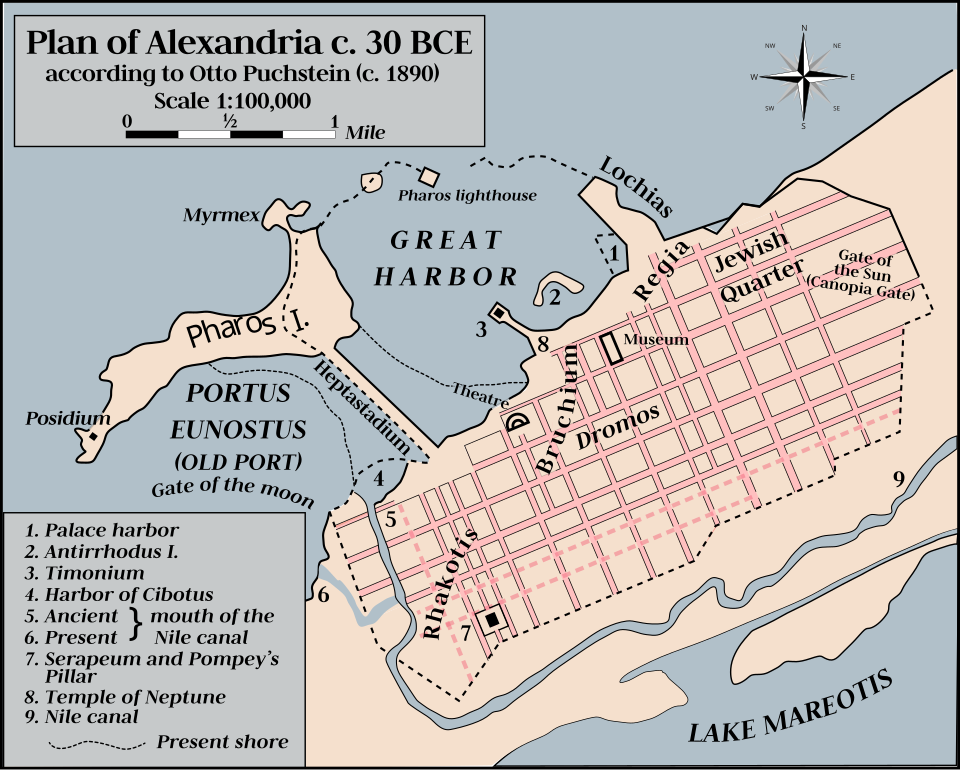
Storage eventually became a logistical nightmare. By the reign of Ptolemy III, the main collection had outgrown its space near the royal palace, prompting construction of a second site at the Serapeum. Located farther from the harbor on higher ground, this “daughter library” wasn’t just a backup. It developed into a research site of its own. Its elevated location would later matter a great deal, keeping those scrolls above water when the coastline eventually gave way.
Key Figures
The Scholars Who Actually Worked There
What the Mouseion Actually Produced
The names attached to Alexandria read like a syllabus for the ancient sciences. Eratosthenes, a head librarian, calculated the Earth’s circumference using shadow angles and landed remarkably close to the modern figure. Euclid taught in Alexandria while compiling the Elements, shaping mathematics for the next two thousand years. Herophilus advanced human anatomy through dissection, long before it was widely accepted. Aristarchus of Samos even proposed a heliocentric model of the solar system roughly 1,700 years before Copernicus.
Callimachus tackled a less glamorous but arguably more consequential problem: how do you organize hundreds of thousands of scrolls so anyone can actually find something? His Pinakes catalogued works by author, subject, and genre. It functioned as one of the earliest known library classification systems. Without it, the collection would have just been an unusable pile of papyrus.
“This is a murder mystery with a number of suspects, and passions still run high on this matter.”
Roger S. Bagnall, Classical HistorianThe Evidence
Myth vs. Evidence: What the Logs Reveal
This is where popular retellings fall apart. A dramatic fire, a single villain, a sudden catastrophic loss it’s a satisfying story precisely because it’s simple. The ancient sources aren’t nearly that tidy.
Julius Caesar torched the Library during his siege of Alexandria in 48 BC, destroying the ancient world’s greatest collection in a single afternoon.
Plutarch and Seneca do describe a fire tied to Caesar’s siege. The loss was real. But classicist Luciano Canfora argues the burned material was more likely stock in dockside warehouses awaiting export. Scholarship and acquisitions continued in Alexandria for centuries afterward.
A Christian mob burned the Library to the ground in 391 AD under orders from Bishop Theophilus.
Theodosius I did sanction the destruction of Alexandria’s pagan temples, and the Serapeum was torn down. Five surviving contemporary accounts describe this event. None of them mention a library burning. By 391, the original Royal Library likely hadn’t functioned as an active institution for a very long time.
Strip away the individual myths, and a different, less cinematic picture takes shape. A royal power struggle expelled scholars in 145 BC. A dockside fire hit in 48 BC. Repeated sieges under Aurelian ravaged the city in the 270s. An earthquake and tsunami in 365 CE swallowed parts of the royal quarter into the sea. And finally, the Serapeum complex fell in 391 CE. There is no single culprit. It was just an institution that lost funding, lost scholars, lost buildings, and eventually lost its reason to exist, slowly, over four hundred years.
| Event | Date | What Actually Happened |
|---|---|---|
| Ptolemy VIII Purge | 145 BC | Foreign scholars, including head librarian Aristarchus, expelled during a succession dispute. |
| Caesar’s Siege Fire | 48 BC | Harbor fire likely damaged warehouse stock; core collection reportedly survived. |
| Aurelian’s Campaigns | 270s CE | Repeated military conflict in Alexandria as Rome reclaims territory from the Palmyrene Empire. |
| Earthquake & Tsunami | 365 CE | Coastal subsidence submerges parts of the royal quarter, the original Library’s home district. |
| Serapeum Destroyed | 391 CE | Temple demolished under Theodosius I’s anti-paganism decree; no source confirms a library burned. |
The Environment
The Invisible Enemy: The Climate of Alexandria
There’s another crucial factor that historians often overlook when discussing the destruction of ancient texts: the physical fragility of papyrus itself. In the dry, arid deserts of Oxyrhynchus, thousands of ancient papyri survived naturally for millennia. Alexandria, however, was a humid coastal city.
In that environment, a papyrus scroll will rot and disintegrate unless it is meticulously maintained and continuously recopied. The texts didn’t necessarily need a fire to vanish. Once the Ptolemaic and Roman treasuries stopped funding the scribes to maintain the collection, the climate simply did the rest of the work. You don’t have to burn a book to destroy it. You just have to stop paying someone to preserve it.
Turning Point
The Serapeum’s Final Chapter

Theodosius, Theophilus, and the End of the Serapeum
By the late fourth century, tensions between Alexandria’s Christian population and its remaining pagan community had been building for years. In 391 CE, Bishop Theophilus led the demolition of the temple, acting under authority Theodosius I had granted for dismantling pagan shrines across the empire. A church was built on the site afterward.
But here’s the odd part. While the rhetorician Aphthonius observed active book repositories within the Serapeum’s colonnades as late as 315 CE, five separate contemporary accounts of the demolition in 391 CE survive and not one of them mentions books burning. It’s plausible some manuscripts were destroyed or scattered in the chaos. But it’s equally likely the collection had already been dispersed, sold off, or simply left to decay long before 391 arrived. The specific dramatic image of mobs torching scrolls was likely added by later storytellers rather than eyewitnesses.
The Aftermath
What the Loss Actually Cost, and What Survived
It’s tempting to treat the Library’s disappearance as a clean break a hard stop between an age of knowledge and an age of ignorance. That framing feels dramatic, but it doesn’t match the evidence. Greek scholarship didn’t simply vanish with Alexandria’s decline. Euclid’s geometry survived through continuous copying across the medieval Islamic world and Byzantine scriptoria. Ptolemy’s astronomical work persisted through Arabic translation and eventually reshaped European science during the Renaissance.
What was genuinely lost is harder to quantify: works that existed in only a handful of copies, texts never translated out of the original language, scholarship that simply didn’t survive the ordinary attrition every ancient library faced. That’s arguably the more honest tragedy. Not one dramatic afternoon of loss, but centuries of institutions slowly losing funding and relevance as the political center of gravity shifted away from Alexandria toward Rome and later Constantinople.
Modern Echoes
The Modern Echo: Bibliotheca Alexandrina

A Deliberate Act of Historical Memory
Egypt, UNESCO, and a coalition of international partners opened the Bibliotheca Alexandrina in 2002, positioned close to the ancient harbor and designed as an unmistakable homage to its predecessor. It isn’t a reconstruction; nobody knows enough about the original building’s layout to reconstruct it faithfully. It’s closer to a statement. The idea the ancient institution represented gathering the world’s knowledge in one accessible place was worth trying again, even after two thousand years of proof that no library lasts forever without continuous investment.
Conclusion
An Institution, Not a Single Building
The Library of Alexandria wasn’t destroyed. It was worn down. Across four centuries, it was battered by war, politics, natural disaster, and religious conflict, until eventually there was nothing left to describe as an active institution. That’s a less satisfying story than the one involving a single fire and a single villain. It’s also, as far as the surviving evidence allows us to say, the true one. The scholars were the part that actually mattered anyway. The building was just where they happened to work.
Review the Historical Archives
Classical Scholarship
- Canfora, Luciano (1989). The Vanished Library: A Wonder of the Ancient World. University of California Press. Reinterprets Caesar-fire testimony as warehouse loss, not core-collection destruction.
- MacLeod, Roy (Ed.) (2000). The Library of Alexandria: Centre of Learning in the Ancient World. I.B. Tauris. Multi-author survey of the institution’s founding, scholarship, and decline.
- Bagnall, Roger S. “Alexandria: Library of Dreams.” Proceedings of the American Philosophical Society. Reviews competing destruction narratives and their evidentiary basis.
Ancient Testimony
- Plutarch, Life of Caesar. Contemporary-adjacent account describing fire spreading from the dockyards during Caesar’s siege.
- Seneca, De Tranquillitate Animi, citing Livy’s now-lost History of Rome on scroll losses in the 48 BC fire.
- Codex Theodosianus, XVI.10.11. Imperial decree authorizing the destruction of pagan temples, including the Serapeum.
Reference & Museum Sources
- Oxyrhynchus Papyri Project: Survival data contrasting dry desert preservation against humid coastal decay.
- World History Encyclopedia: Archaeological and textual survey of the Serapeum’s destruction and its aftermath.
System Index