

Archaeological Report Historical Preservation
20 Historical Artifacts That Survived Against the Odds
We usually assume ancient artifacts survive because they were carefully guarded. The physical record reveals a far more complex forensic puzzle where deliberate human deposition meets the unpredictable luck of permafrost, bogs, and administrative recycling.

Walking through a modern museum, it is easy to view history as an orderly, curated collection of human memory. But my reading of the evidence suggests something much more complex. While many objects were deliberately designed for eternity and carefully cached by their makers, their physical survival to the present day often relied on accidental chemical anomalies and environmental quirks. The artifacts that make it to us do not just tell a story of ancient intent. They represent an investigative revelation where deliberate human burial met the unpredictable luck of sudden freezes, highly acidic bogs, and bizarre administrative reuse.
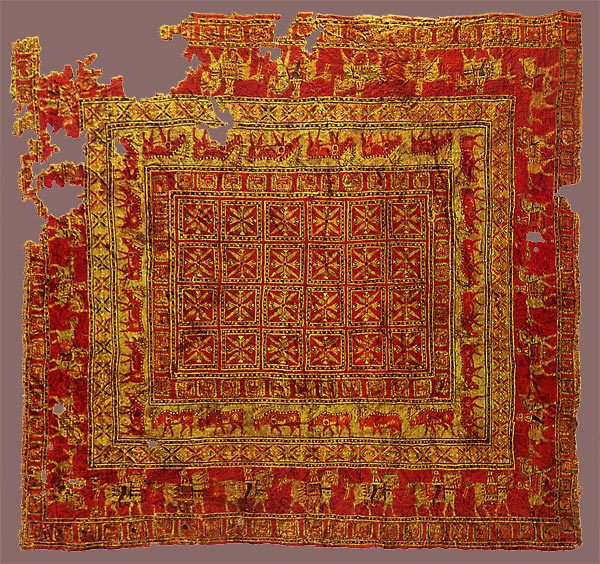
The Pazyryk Carpet
I find the survival of the Pazyryk carpet incredibly ironic. It is the oldest known surviving knotted-pile carpet in the world, yet it only exists today because tomb robbers desecrated the burial chamber shortly after it was sealed.
The looters broke into the wooden chamber beneath the stone kurgan, stole the gold, and left their vertical access shaft open. Rainwater seeped into the tomb and flooded it. Because of the harsh Siberian climate, the water permanently froze. This created an artificial permafrost ice lens that deep-froze the organic sheep’s wool for over two millennia until its excavation in 1949. Remarkably well-preserved rather than perfect, its vivid madder, kermes, and Polish or Armenian cochineal dyes still show.
While we know exactly how it survived, its origins remain intensely debated. Some scholars argue it was an imported Persian luxury, while others suggest local nomadic or Armenian production.

The Rosetta Stone
We often think of the Rosetta Stone as a celebrated linguistic key, but for over a millennium, it simply served as structural infrastructure. Carved from heavy granodiorite in 196 BCE, it was later broken up and repurposed as cheap foundation rubble to construct Fort Julien, a medieval Mamluk fortress in the Nile Delta.
It wasn’t hidden or meant to be a secret. This was a highly public royal decree intended for mass communication across Ptolemaic society. According to the British Museum’s records, it survived precisely because medieval builders treated it as worthless brick, inadvertently shielding it from weathering and destruction. It wasn’t until French engineer Pierre-François Bouchard was repairing the fort in 1799 that it was recognized. It provided the crucial key for deciphering hieroglyphs, even if Champollion also needed other comparative texts to finish the job.

Tollund Man
When peat cutters uncovered Tollund Man in Denmark in 1950, his facial features were so remarkably preserved that they called the police, assuming he was a recent murder victim. In reality, he had been dead for over 2,300 years.
I don’t think the evidence really shows this was an accidental drowning. The carefully placed leather noose overwhelmingly suggests a deliberate ritual sacrifice where he was intentionally deposited into the bog. His survival relies on the highly specific chemistry of raised sphagnum peat bogs. The oxygen-poor, acidic water and a specific polymer in the moss called sphagnan naturally tanned his skin and halted bacterial decay entirely. A fascinating 2021 study in Antiquity revealed his final meal included a porridge of barley, flax, pale persicaria, and threshing waste.

Carolingian Manuscript Fragment
Thousands of lost medieval texts only survive today as structural trash. As ancient handwritten texts became obsolete following the invention of the printing press, 15th and 16th-century bookbinders took a highly practical approach. They sliced up expensive medieval parchment and glued it inside the spines of newer printed books to reinforce them.
This process, known as maculature, means that the physical destruction of the original book is the primary reason fragments like this 9th-century text survived. Modern archivists now carefully disassemble damaged Renaissance bindings just to read the medieval material glued inside.

16th-Century Hagiographic Fragment
During the Protestant Reformation, Catholic liturgical texts were rendered theologically obsolete. They were deliberately removed from circulation in massive numbers.
However, the animal parchment they were written on was still incredibly durable and valuable. Rather than destroying them, pragmatic state tax bailiffs in regions like Scandinavia confiscated the manuscripts and recycled the parchment to serve as protective covers for their financial account books. Collections like the Fragmenta Membranea in Finland and the Swedish Riksarkivet prove this uncurated, bureaucratic recycling is one of the strongest genuine accidental preservation stories we have. The reformers successfully preserved the text by actively trying to repurpose it.

Har-Mose’s Lute
Constructed of cedar wood, a rawhide soundboard, and gut strings, this instrument should have rotted into dust millennia ago. It belonged to Har-Mose, a singer during the reign of Hatshepsut, and is one of the world’s oldest surviving stringed instruments.
Its survival is largely due to the hyper-arid microclimate of the Theban necropolis. Once the tomb was sealed, the extremely low humidity halted organic decomposition. The preservation was so effective that when the Metropolitan Museum of Art excavated it in the 1930s, the ancient plectrum was found still attached to the instrument by a cord.

The Nebra Sky Disk
The Nebra Sky Disk is widely celebrated as a prehistoric map of the cosmos, but what stands out to me is the fierce archaeological controversy surrounding it. It survived because its final owners deliberately buried it in a stone cist on the Mittelberg hill. This intentional caching safely isolated the bronze from acidic soils and deep agricultural plows.
While many scholars firmly present it as a 1600 BCE Unetice astronomical map (a view championed by Ernst Pernicka), competing researchers like Rupert Gebhard and Rüdiger Krause argue it belongs to the Iron Age (circa 500 BCE) and holds shamanistic significance. Presenting its history requires acknowledging this major chronological dispute, keeping the disk an active forensic puzzle.

Lapis Lazuli Cuneiform Tablet
Most Mesopotamian cuneiform tablets were made of unfired clay, which easily dissolves back into mud when exposed to high groundwater. This foundation tablet, however, was carved into solid lapis lazuli imported over 2,000 miles from Afghanistan.
Because lapis is a metamorphic rock, it is highly resilient to biological decay and chemical erosion. It wasn’t accidentally lost. Foundation deposits like this one were intentionally buried deep within temple brickwork in Sippar. My reading of the evidence is that they were engineered to communicate the king’s piety to the gods and future rulers, utilizing vast Bronze Age trade networks to secure the precious material.

The Trundholm Sun Chariot
During the Bronze Age, metal was incredibly scarce and valuable, meaning old objects were almost always melted down and recast. The Trundholm Sun Chariot escaped this cycle of aggressive recycling through deliberate religious sacrifice.
It was intentionally dismantled and dropped into a peat bog as a votive offering. Sinking into the bog safely removed it from the metalworkers’ furnace. It remained there until a Danish farmer plowed it up in 1902, initially letting his son play with the ancient bronze horse, thinking it was just an old discarded toy.

Ancient Egyptian Mummification Needle
Ancient Egyptian embalming tools give us physical proof of the surgical reality behind mummification. But they didn’t just accidentally survive as discarded trash. Archaeological evidence from sites like Tutankhamun’s famous KV54 embalming cache demonstrate that materials touching a royal corpse often absorbed the king’s sacred essence.
Because these items became ritually impure for mundane use, priests respectfully collected and deliberately hid many of them in separate, arid cache pits. This intentional religious caching, combined with the dry desert climate, accidentally ensured the tools and materials survived in excellent condition.

Roman Coin Hoards
We find thousands of Roman silver denarii buried across Europe today, but their presence is rarely a sign of immense wealth. Some hoards may reflect economic panic or catastrophe, such as periods of hyperinflation, civil war, or localized unrest, during which citizens treated the earth as a safe deposit box.
Archaeologists interpret individual hoards differently, but many survived because the original owners were either killed or permanently displaced. The deliberate human act of caching the coins met the tragedy of an undocumented human event that prevented the owner from ever returning to dig them up.
“The artifacts that make it to us do not just tell a story of ancient intent, they represent an investigative revelation where deliberate human burial met the unpredictable luck of chemistry.”
Research Audit Notes
“William the Hippo”
Found in the tomb of Senbi II, this brilliantly glazed blue quartz ceramic (faience) hippopotamus survived largely because he was intentionally broken before burial.
Egyptologists widely interpret this practice through the lens of sympathetic magic. Because hippos were incredibly dangerous in the physical world, scholars suggest the statuette’s legs were deliberately snapped to prevent it from magically coming to life and trampling the deceased in the afterlife. By rendering him harmless, they ensured he remained safely sealed in the dry tomb. The intact legs seen in museums today are modern restorations.

Ancient Cypriot Plaster-Repaired Jar
We tend to view ancient artifacts as pristine objects, but this Cypriot jar tells a story of ancient desperation and conservation. Archaeological evidence shows that ceramic vessels like this were not always discarded when broken. Instead of sweeping the fragments into a midden, an ancient craftsman painstakingly glued this shattered jar back together using gypsum plaster.
Placed deliberately in a burial or storage context, it survived the centuries as a heavily repaired, functional object. It proves that material scarcity often drove early humans to become the first historical conservators.

Ancient Roman Bronze Medical Probe
Fine bronze tools usually corrode into dust or are melted down for scrap. Highly specialized surgical instruments like this dual-purpose probe (specillum) rarely enter the archaeological record through normal discard.
While specimens of this caliber generally only survive when caught in sudden catastrophic events—such as comparative tools sealed instantly in volcanic ash at Pompeii, or dropped into the anaerobic mud of the River Thames—they offer proof that Roman surgical designs were remarkably close to the tools used in modern operating rooms.

Sumerian Stone Building Inscription
This limestone foundation inscription was built to be completely invisible. Examining ancient urban infrastructure, we find that Mesopotamian kings intentionally buried these texts deep beneath the massive brick corners of their ziggurats and temples.
When rival empires eventually sacked these cities and burned them to the ground, the fires and the later desert sands simply passed over the deep foundation deposits. These texts were placed where living citizens would not see them, yet this structural foresight helped preserve royal chronologies for modern archaeologists.

Cypro-Archaic Terracotta Figurine
When an ancient temple became too cluttered with thousands of clay offerings from citizens, priests faced a practical challenge. They couldn’t simply throw the statues in the trash because they technically belonged to the gods.
To solve the issue, priests dug deep pits near the sanctuary known as bothroi (sacred dumps) and carefully buried the overflow. This administrative housekeeping accidentally hid the figurines from later religious iconoclasts and severe weather, preserving their unique fusion of Greek, Egyptian, and Near Eastern art styles.

The Langeid Viking Sword
Most iron swords from the Viking Age rust to nothing in the highly acidic soil. According to the Museum of Cultural History in Oslo, the Langeid sword features intricate silver and gold hilt inlays. In the same Grave 8, archaeologists found a broadaxe whose organic wooden haft survived because it was wrapped in a brass band.
The copper alloy leached into the wood, helping to inhibit decay for a millennium. My reading of the evidence highlights a profound cultural tension: the sword is adorned with Christian iconography (including the Latin letters for Christ the Savior) yet was deliberately deposited in a pagan burial, reflecting a society in religious transition.

The Lycurgus Cup
Unlike most Roman glass which is found shattered in archaeological dirt, the Lycurgus Cup survived entirely above ground. It is the only complete example of dichroic glass, changing from opaque green in reflected light to glowing red when light shines through it.
The British Museum notes this was achieved by infusing the glass matrix with precise proportions of gold and silver nanoparticles. It wasn’t accidentally buried. Evidence suggests its survival is due to continuous human curation above ground, likely passing safely through early medieval church treasuries and later aristocratic collections.

Peking Observatory Zodiacal Sphere
During the Boxer Rebellion in 1900, the German army looted the Beijing Observatory and shipped this colossal bronze astronomical instrument to the Kaiser’s palace in Potsdam.
It survived the massive scrap-metal drives of World War I largely because of its artistic prestige. It was preserved and eventually returned to China under Article 131 of the Treaty of Versailles. It remains one of the rare ancient artifacts whose survival and restitution were explicitly negotiated in a global world-war treaty.
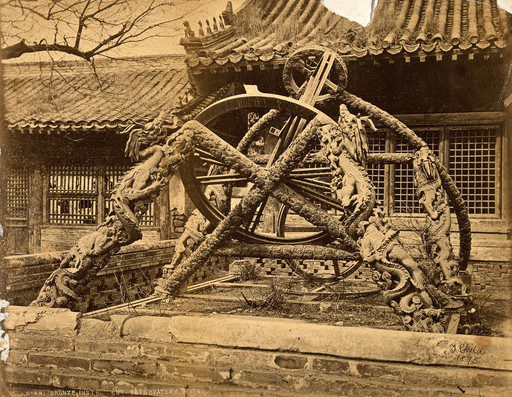
Peking Observatory Bronze Altazimuth
While the Zodiacal sphere survived via treaty, a significant factor in why these grand Qing Dynasty instruments survived the collapse of the empire without being melted down for ammunition is their immense mass.
The intricate dragons aren’t just decorative. Their mass is the architectural anchor that kept the instruments safe. Weighing several tons each, they were physically prohibitive for local opportunists to quietly scrap. They show how raw scale and weight can act as a physical deterrent against historical erasure.
The Infrastructure of Survival
The archive of human history is far more complex than simple curation. We owe our understanding of the past to an intricate combination of deliberate human engineering, religious ritual, and the sheer luck of soil chemistry. Every artifact that survived the churn of history did so against overwhelming odds. By analyzing how these objects escaped destruction, we stop viewing history as a steady narrative and recognize it for what it is: a forensic log where ancient human intention meets the unpredictable accidents of nature.
Sources & Further Reading
- The British Museum: Curatorial records detailing the Rosetta Stone (EA24), the Lycurgus Cup, and Sumerian foundation deposits.
- Antiquity Journal (2021): Isotopic and gut-content analysis of Tollund Man detailing his final meal and terrestrial diet.
- The Metropolitan Museum of Art: Excavation data and collection records regarding Har-Mose’s Lute and ancient Egyptian embalming caches (KV54).
- Museum of Cultural History, University of Oslo: Metallurgical and archaeological analysis of the Langeid Viking Sword and Broadaxe (Grave 8).
- State Hermitage Museum: Conservation and dye analysis records tracing the permafrost preservation of the Pazyryk Carpet.
- National Archives (Riksarkivet): Archival history regarding the Fragmenta Membranea and the post-Reformation maculature of medieval texts.
Frequently Asked Questions
Addressing common misconceptions regarding archaeological preservation.
Why does bronze survive better than iron?
Iron oxidizes (rusts) aggressively when exposed to oxygen and moisture, eventually flaking away to nothing. Bronze develops a layer of surface oxidation called a patina, which actually seals and protects the underlying metal from further decay.
How do bogs preserve human bodies?
Sphagnum peat bogs create a highly acidic, cold, and oxygen-deprived environment. A specific polymer in the moss called sphagnan naturally tans human skin and halts bacterial decomposition.
Were the Rosetta Stone languages deciphered immediately?
No. While it was discovered in 1799, it took scholar Jean-François Champollion until 1822 to fully decipher the Egyptian hieroglyphs. The stone wasn’t a hidden puzzle, but a highly public Ptolemaic decree designed for mass communication.


[…] documents or artifacts manage to survive the centuries to tell these stories, I recommend exploring how historical artifacts survive against the odds, as only one single copy of this 1507 map is known to exist today, discovered in a German castle in […]