Deep Research Ancient Math
The Counting System That Built America:
How Babylonian Math Still Controls
Your Money, GPS, and Time
Every time you check your phone at 3:17 PM, use Google Maps, or split a bill, you are running 4,000-year-old Babylonian mathematics. The United States never built its own counting system. It inherited one — and the history of how that happened is stranger than anyone teaches.
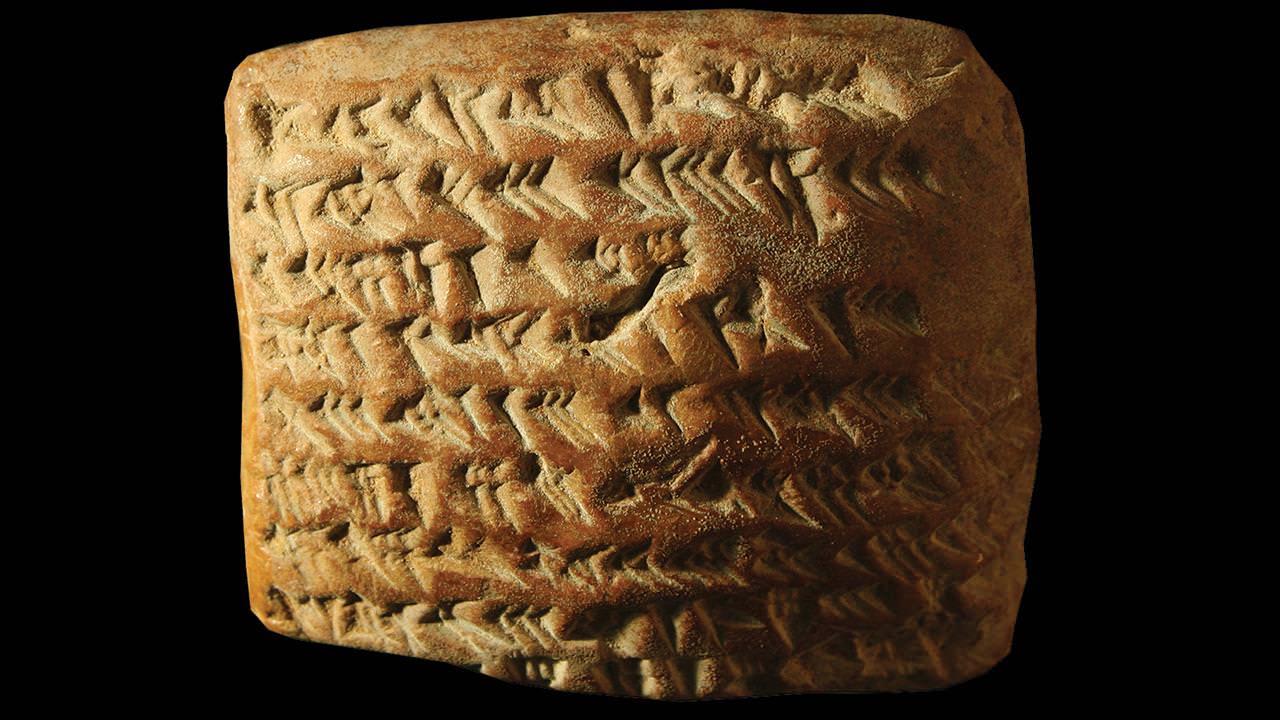
An Old Babylonian clay tablet inscribed with cuneiform mathematical calculations — the physical record of the base-60 sexagesimal system still running inside every clock, GPS receiver, and angular measurement on Earth today
American schoolchildren learn that Thomas Jefferson shaped the American landscape and that time zones were an American invention. Almost none learn that the numbers underneath both systems — the 60 seconds in a minute, the 360 degrees in a circle, the degrees and minutes in every GPS coordinate — were inherited from an empire that collapsed more than 2,500 years ago. Every time you read 3:17 PM, you are reading Babylonian math. This is the hidden counting system that America runs on.
Section 01 — The Hook
The Math Hiding in Your Phone: A 4,000-Year-Old Operating System
Look at the time. Whatever it says — 2:47, 11:32, 8:15 — you are using the Babylonian math system—the world’s oldest invisible operating system. The hour is divided into 60 minutes. The minute is divided into 60 seconds. The second is divided into fractions of itself in base-10 — but every level above that? Base-60. Pure Babylonian.
Now open Google Maps. Your location is expressed in degrees, minutes, and seconds of latitude and longitude. Each degree contains 60 arc-minutes. Each arc-minute contains 60 arc-seconds. The GPS satellite orbiting 20,000 kilometres above your head is transmitting position data that your phone converts from decimal back into a format that traces its architecture directly to ancient Mesopotamian astronomical tables.
To a modern engineer, none of this is surprising — it’s simply how the systems work. But the reason it works this way, and why no one has changed it, is a story that runs four thousand years and crosses four continents.
The Babylonian math system is a base-60 (sexagesimal) positional numeral system developed in ancient Mesopotamia around 2000 BCE. Unlike the modern decimal system’s base of 10, it groups values in multiples of 60 — which is why there are 60 seconds in a minute, 60 minutes in an hour, 360 degrees in a circle, and 60 arc-minutes in each GPS degree. It remains in daily active use in timekeeping, angular measurement, and global navigation.
The system is so deeply embedded that questioning it feels like questioning gravity. But the engineering logic behind why base-60 survived — and why no modern civilization has successfully replaced it — is one of the most instructive stories in the history of hidden infrastructure.
Section 02 — The Origin
Before America Had a Dollar, Babylon Invented the System
The story begins in ancient Mesopotamia — the land between the Tigris and Euphrates rivers in what is now Iraq. By around 3000 BCE, Sumerian cities had developed the first true writing system (cuneiform) and the first formal mathematical notation, both driven by the same practical need: large-scale commerce. When a temple administrator in Uruk needed to record how many jars of barley were distributed to 300 workers over 30 days, he needed arithmetic that worked quickly and cleanly at scale.
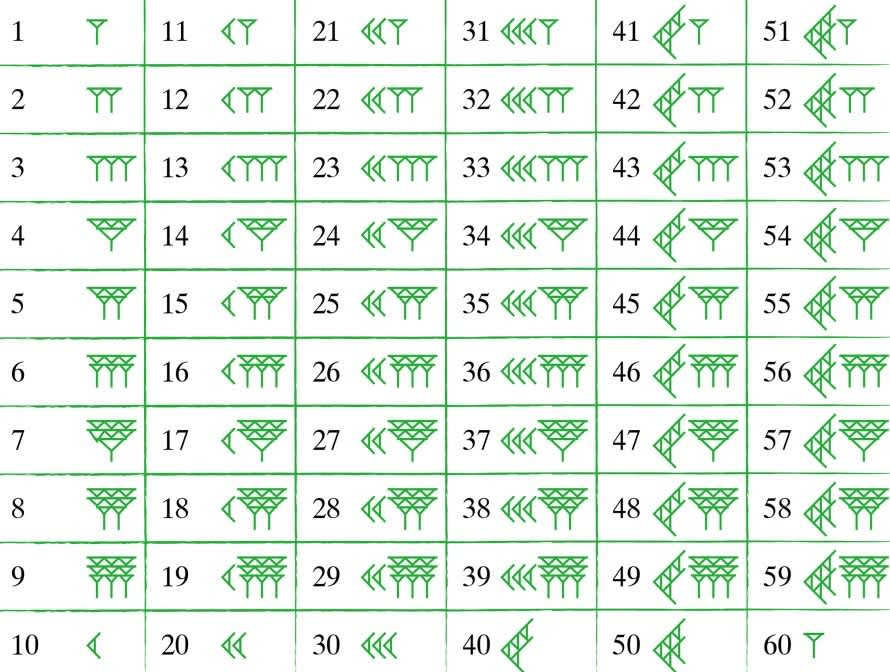
The Sumerians initially worked in base-10 for some calculations and base-6 for others — a dual system that their successors, the Akkadians and then the Babylonians, merged into a unified base-60 positional system around 2000 BCE. The Babylonian system used only two symbols: a vertical wedge for units (1 through 9) and a corner wedge for tens (10, 20, 30, 40, 50). Beyond 59, place values shifted, exactly like the modern decimal system shifts at 9.
Why 60? The Engineering Logic Behind Base-60
This is the question historians have debated for over a century. The practical answer is clean and useful: 60 has more divisors than any smaller positive integer. It can be divided evenly by 1, 2, 3, 4, 5, 6, 10, 12, 15, 20, 30, and 60 — twelve different whole-number divisors. The decimal number 10 has only four: 1, 2, 5, and 10.
For an economy built on dividing grain into rations, splitting land into shares, or calculating interest on loans, this matters enormously. With base-60, a merchant can divide any quantity into halves, thirds, quarters, fifths, sixths, tenths, twelfths, fifteenths, twentieths, or thirtieths — all producing clean whole numbers. With base-10, you get halves and fifths. Everything else produces fractions, and fractions on a clay tablet without a zero symbol are complicated.
Compare the divisibility of competing bases: Base-12 has 6 divisors (used by many ancient cultures for counting months). Base-10 has 4 divisors (the modern decimal system). Base-60 has 12 divisors — more than any integer below it. For a civilization doing real-time commerce, land division, and astronomical calculation without calculators, 60 produced clean fractions that made arithmetic manageable. It wasn’t an arbitrary choice. It was the mathematically optimal base for pre-computational society.
Babylonian mathematicians did not just use base-60 for commerce. They applied it to a level of mathematical sophistication that still astonishes historians. The tablet YBC 7289 — currently held at the Yale Babylonian Collection — shows the square root of 2 calculated in sexagesimal to what amounts to six decimal places of accuracy. The answer matches the modern value to within one part in two million. This was done around 1800–1600 BCE, roughly 3,300 years before the invention of the calculator.
“The Babylonians’ mathematical sophistication has continually surprised modern scholars. Their ability to compute the square root of 2 to six decimal places, using base-60 arithmetic on clay tablets, represents one of the great intellectual achievements of the ancient world.”
Eleanor Robson — Oxford Handbook of the History of Mathematics, 2009Base-10 Decimal
Only 4 divisors. One-third, one-quarter of many quantities produce messy repeating decimals. Works well for counting and multiplying. Poorly suited for dividing into many equal shares without fractions.
Base-60 Sexagesimal
12 divisors — more than any smaller number. One-third equals exactly 20. One-quarter equals exactly 15. One-fifth equals exactly 12. Every common commercial fraction produces a clean whole number. Optimal for a pre-calculator civilization.
Section 03 — The American Connection
Jefferson’s Grid Was Built on Babylonian Math
Thomas Jefferson’s Public Land Survey System — the grid that divided 1.5 billion acres of American land into the checkerboard pattern still visible from any plane window — is often discussed as a triumph of American rational thought. The underlying mathematics, however, is older than Rome. The Babylonian math system provided the angular logic that allowed Jefferson to turn a continent into a grid.
To lay out a survey line running precisely north-south or east-west across an American township, a surveyor using a Gunter’s Chain needed to orient their instrument to a compass bearing. Compass bearings are measured in degrees, minutes, and seconds of arc. The degree is divided into 60 arc-minutes. The arc-minute is divided into 60 arc-seconds. There was no decimal-degree alternative available to 18th-century surveyors. The orientation of every single township line, every section boundary, and every property corner in the entire American land grid was established using the Babylonian sexagesimal system.
Every PLSS deed ever written — describing land as “lying North 45° 30′ 15″ East from the Principal Meridian” — is a document written in Babylonian arithmetic. The most American thing Jefferson ever designed required the math of Babylon to work.
Edmund Gunter — inventor of the 66-foot chain that defined American land — was also the inventor of the logarithmic scale and a leading figure in 17th-century mathematical astronomy. His surveying methods were built entirely on Ptolemy’s angular geometry, which was itself a direct Latin translation of Babylonian astronomical tables preserved through Islamic scholarship. The tool that divided America was forged from Babylonian mathematics. Most Americans have no idea the two are connected.
This is part of a broader pattern the site has documented across multiple investigations. Ancient measurement systems have a way of surviving civilizational collapse because they are embedded in instruments and practices long before anyone writes down why the numbers are what they are. By the time anyone thinks to question them, they are already inside every tool, every table, and every trained practitioner alive.
Section 04 — The Modern System
Why GPS and Timekeeping Still Need Babylonian Minutes
Here is where the story gets genuinely strange.
In the 1970s, when the US Department of Defense designed the Global Positioning System, engineers had a choice. They could express GPS coordinates in any number system they wanted. They were building from scratch, with 20th-century mathematics, funded by the most technologically advanced military in human history. They could have used decimal degrees exclusively. They didn’t — and the reason tells you everything about why ancient infrastructure outlasts the civilizations that created it.
How GPS Uses Babylonian Base-60 — The Full Conversion Chain
The GPS system, designed entirely with modern 20th-century mathematics, converts its internal decimal-degree calculations into Babylonian base-60 for display — the same logic used in NASA’s GPS calculations — because every map, every navigation chart, every aviation system, and every maritime instrument in the world uses degrees-minutes-seconds. The ancient system had too much installed infrastructure to bypass. It was easier to translate to it than to replace it.
The same logic applies to timekeeping. The International Bureau of Weights and Measures defines one second as 9,192,631,770 oscillations of the cesium-133 atom’s ground state, as defined by the NIST Walk Through Time. That is an extraordinarily precise, modern, quantum-mechanical definition. But the second itself — the unit — exists only because a Babylonian astronomer divided the day into 24 hours, each hour into 60 minutes, each minute into 60 seconds. The atomic precision is modern. The unit it measures is Babylonian. The time zones that organize the world are built on top of this same Babylonian architecture.

Section 05 — The Transmission Chain
The 4,000-Year Transmission Chain: From Cuneiform to Your Clock
The survival of Babylonian base-60 through four millennia is not an accident of inertia. It is the result of a specific, traceable chain of deliberate scholarly transmission — each link passing the system forward because it was too mathematically useful to abandon. Understanding that chain is essential to understanding why the system is still with us today.
Babylonian Scribes Formalise Base-60
The Old Babylonian period consolidates earlier Sumerian numerical practices into a fully positional base-60 system. Scribes produce mathematical tables for multiplication, reciprocals, and square roots. The system is embedded in thousands of clay tablets used for temple accounting, land surveying, and astronomical observation.
Astronomical Tables Encode Sexagesimal Time
Babylonian astronomers — the same scribal class who maintained the mathematical tables — begin producing detailed records of planetary positions, lunar cycles, and solar movements. They express all angular measurements and time intervals in base-60. These tables will be copied, referenced, and translated for the next 1,500 years.
Hipparchus Adopts the System for Greek Astronomy
Greek astronomer Hipparchus — working with Babylonian astronomical records — adopts the base-60 system for his star catalogue and develops the chord tables that will become trigonometry. He divides the circle into 360 degrees (6 × 60, matching the Babylonian astronomical convention) and subdivides each degree into 60 minutes. Greek astronomy absorbs the Babylonian numerical system wholesale.
Ptolemy’s Almagest — The System Becomes Standard
Claudius Ptolemy’s Almagest — the comprehensive mathematical astronomy text that will dominate Western and Islamic scholarship for 1,400 years — uses sexagesimal notation throughout. His star tables, planetary calculations, and coordinate system are all base-60. Every astronomer who reads the Almagest for the next fourteen centuries works in Babylonian arithmetic.
Islamic Scholars Translate and Transmit
The House of Wisdom in Baghdad — the most sophisticated scholarly institution of the medieval world — produces Arabic translations of Ptolemy and other Greek mathematical texts. Al-Khwarizmi, al-Battani, and others extend Babylonian astronomical mathematics. Their Arabic translations preserve and transmit the sexagesimal system to medieval Europe. The words “minute” (from Latin pars minuta prima, first small part) and “second” (pars minuta secunda, second small part) enter European languages through this transmission.
Gunter Encodes Sexagesimal Angles in American Surveying
Edmund Gunter, whose 66-foot chain will define the American land grid, works entirely within the sexagesimal angular system for compass bearings. His surveying methods require base-60 arithmetic for every orientation calculation. When Congress adopts his chain for the Public Land Survey System in 1785, it embeds Babylonian angular mathematics into the legal foundation of the United States.
France Tries Decimal Time — and Fails Within Two Years
Revolutionary France introduces decimal time: 10 hours per day, 100 minutes per hour, 100 seconds per minute. They also introduce the grad (400 gradians per circle) for angular measurement. Both systems are officially abandoned within two years. The installed base of sexagesimal clocks, navigation instruments, and astronomical tables is simply too large to replace. The network effects of the existing system proved more powerful than revolutionary ideology.
GPS Adopts Babylonian Coordinate Format
The US Department of Defense launches the first GPS satellite. The system expresses position in decimal degrees internally but converts to degrees-minutes-seconds for output — because every navigation chart, aviation system, and maritime instrument in the world uses DMS. Four thousand years of accumulated infrastructure forces the most sophisticated navigation technology in human history to speak Babylonian.
Section 06 — Scholarly Debate
Not Every Historian Agrees: Where the Evidence Gets Complicated
The narrative above — Babylon invents base-60, Greece receives it, Islam preserves it, Europe transmits it to America — is broadly accurate. Historians largely agree on the broad lines. But the closer you look at any link in that chain, the more contested the details become.
Areas of Ongoing Scholarly Debate
Did the Sumerians or the Babylonians formalise base-60?
The standard account credits the Old Babylonian period (c. 2000–1600 BCE) with formalising the positional sexagesimal system. But historian Jöran Friberg and others have argued that the underlying structure was already present in earlier Sumerian administrative texts dating to the third millennium BCE. The credit belongs somewhere on a continuum — not to a single culture at a single moment. Scholars still debate exactly when a dual-register system became a unified positional one.
Is the divisibility argument the real reason — or a post-hoc rationalisation?
The “60 has 12 divisors” explanation is widely cited and mathematically compelling. It is also, as historian Marvin Powell noted, difficult to verify as the actual motivation. Ancient scribes left no record explaining why they chose 60. The divisibility argument may describe why the system survived better than it explains why it was chosen. Some scholars favour a simpler explanation: the combination of Sumerian base-10 finger counting with Akkadian base-6 hand counting produced 60 by multiplication, not by design.
How direct is the Babylon-to-GPS transmission chain?
The transmission through Hipparchus and Ptolemy is well-documented and undisputed. The Islamic translation movement is also solid. Where historians exercise more caution is in claims of unbroken direct transmission at each step — particularly the jump from medieval Islamic scholarship to early modern European practice. There were parallel independent developments in several traditions. The transmission was real, but it was also messy, partial, and sometimes reconstructed rather than strictly inherited.
The scholarly consensus holds that base-60’s Babylonian origins are real and that the transmission chain to modern use is genuine — but the causal details are more complicated than any clean narrative allows. The sources in Section 09 reflect this complexity.
None of these debates undermine the central claim: that the system is Babylonian in origin and that it reached the modern world through the scholarly chain described above. They do, however, remind us that history rarely moves in straight lines. The transmission of a mathematical system across four thousand years is less like passing a baton and more like a river — same water, same direction, but constantly shifting course.
Section 07 — Why It Survived
Why America Never Replaced the Babylonian System: The Infrastructure Lock-In
This brings us to the question that every student who learns this history immediately asks: why hasn’t a modern country simply replaced the base-60 time and angle system with something decimal? The metric system replaced dozens of pre-modern measurement systems in the 19th century. Why couldn’t it replace base-60 as well?
The answer is what economists call network effects — and it’s the same reason the railroad gauge that became American standard became an almost impossible-to-change fact of infrastructure: the value of any standard comes partly from how many other people are using it. When millions of clocks, sextants, navigation charts, astronomical tables, artillery tables, and trained professionals all use the same sexagesimal conventions, the cost of switching isn’t just the cost of changing the instruments. It’s the cost of retraining every operator, reprinting every table, recalibrating every clock, and re-surveying every chart — simultaneously, everywhere, in perfect coordination.
France learned this the hard way in 1793.
The Revolutionary government — the same government that successfully metrified length, weight, and volume — introduced decimal time and decimal angles. The decree had legal force. The ideology behind it was impeccable. The existing infrastructure simply ignored it. Clock makers didn’t retool. Navigators didn’t discard their sextants. Within two years, the government quietly dropped both systems and went back to Babylonian math.
The system that absorbed the decimal revolution without changing was over three thousand years old by the time Napoleon was born. Some systems run too deep to replace.
Base-60 vs Base-10 — Where Each System Won and Why
| Domain | System Used | Why That System Won | Babylonian Origin? |
|---|---|---|---|
| Timekeeping | Base-60 (hours/minutes/seconds)60 sec per min, 60 min per hour | Network effects: every clock in history built to this standard | ✓ Direct — Babylonian astronomers, ~700 BCE |
| GPS Coordinates | Base-60 display (DMS)Internal decimal, displayed as sexagesimal | All navigation charts, sextants, and aviation instruments use DMS | ✓ Direct — Hipparchus → Ptolemy → GPS |
| Angular Measurement | Base-60 (degrees/arc-min/arc-sec)360° = 21,600′ = 1,296,000″ | 360 degrees chosen by Babylonian astronomers for divisibility | ✓ Direct — Babylon c. 2000 BCE |
| Currency/Commerce | Base-10 (decimal)Dollars, cents, percentages | Metric revolution succeeded here — no pre-existing network lock-in | ✗ Decimal replaced Babylonian fractions in commerce |
| Scientific Measurement | Base-10 (SI units)Metres, kilograms, seconds as base units | Scientific community successfully coordinated a switch; instruments rebuilt | Mixed — SI second defined from Babylonian second unit |
| Land Survey Bearings (US) | Base-60 (degrees/minutes/seconds)All PLSS deed descriptions | Every existing deed, instrument, and legal description uses DMS | ✓ Via Gunter / PLSS 1785 — Babylon by way of Ptolemy |
Section 08 — Frequently Asked Questions
FAQ: The Babylonian Math System
The most-searched questions about base-60 sexagesimal mathematics, its Babylonian origins, and why it still controls modern timekeeping, GPS, and American surveying.
QWhy are there 60 minutes in an hour?
There are 60 minutes in an hour because of the ancient Babylonian base-60 sexagesimal number system. Babylonian astronomers divided time using base-60 because 60 is divisible by 1, 2, 3, 4, 5, 6, 10, 12, 15, 20, and 30 — twelve whole divisors that made splitting any time interval into equal parts easy without fractions. Greek astronomers Hipparchus and Ptolemy adopted this system, Islamic scholars preserved it, and medieval European scholars transmitted it into the clocks that became the global standard. The 60-minute hour is 4,000 years old and has survived every attempt to replace it.
QWhat is the Babylonian base-60 math system?
The Babylonian base-60 (sexagesimal) number system is a positional numeral system that groups values in multiples of 60 rather than 10. Developed in ancient Mesopotamia around 2000 BCE, it used two cuneiform symbols — a vertical wedge (1) and a corner wedge (10) — combined in groups up to 59, with place values shifting beyond that. It remains in active daily use for measuring time (60 seconds per minute, 60 minutes per hour), angles (360 degrees, 60 arc-minutes per degree, 60 arc-seconds per arc-minute), and GPS coordinates. See the GPS conversion diagram →
QWhy did the Babylonians use base 60?
The most widely accepted explanation is mathematical utility: 60 is divisible by 12 different whole numbers — more than any smaller positive integer. For a civilization doing commerce, land measurement, and astronomy without calculators, this made dividing any quantity into common fractions (halves, thirds, quarters, fifths, sixths) produce clean whole numbers rather than messy decimals. Historians note, however, that this may describe why the system survived rather than why it was originally chosen — see Section 06 for the scholarly debate on that distinction.
QHow does Babylonian math affect modern GPS?
Every GPS coordinate on Earth is displayed in degrees, minutes, and seconds of latitude and longitude — a format derived directly from Babylonian sexagesimal mathematics. When your phone shows 40°44’54″N 73°59’08″W, those degree subdivisions (60 arc-minutes per degree, 60 arc-seconds per arc-minute) are the Babylonian system applied to geography. GPS satellites transmit decimal-degree position data that navigation software converts to DMS format for display — running the 4,000-year-old Babylonian arithmetic dozens of times per second. See the full conversion chain →
QDid Jefferson’s grid use Babylonian math?
Yes, foundationally. Every township line and section boundary in the Public Land Survey System was established by surveying compass bearings in degrees, arc-minutes, and arc-seconds — the Babylonian sexagesimal system. Every PLSS deed ever written with a bearing description (“N 45° 30′ 15″ E”) is a document written in Babylonian arithmetic. The grid that shaped American land cannot be surveyed without base-60 angular mathematics. Read the full connection →
QWhy didn’t the metric system replace base-60 for time and angles?
France tried in 1793 — they introduced decimal time (10 hours per day, 100 minutes per hour) and decimal angles (400 gradians per circle). Both were abandoned within two years. The problem was network effects: every existing clock, sextant, navigation chart, astronomical table, and trained professional used the sexagesimal system. Replacing it required simultaneous coordination across every instrument and practitioner on Earth. The Metric Revolution succeeded for length, weight, and volume because those units had no equivalent network depth. Time and angles had 3,000 years of embedded infrastructure. They were effectively unreplaceable.
The World’s Longest-Running Operating System
When Americans talk about their founding mathematicians, they mention Jefferson’s decimal obsessions, Hamilton’s financial models, and Franklin’s experiments. Almost no one mentions the scribes of ancient Babylon — the people whose counting system Jefferson’s surveyors used, whose timekeeping system Franklin’s clocks measured, and whose angular notation every GPS satellite still transmits today.
Base-60 has survived the fall of Babylon, the collapse of Greece, the fragmentation of Rome, the conversion of Europe to Christianity, the rise and fall of the Islamic Golden Age, the Scientific Revolution, the metric revolution, and the digital age. It survived all of those not because anyone chose to preserve it, but because it was embedded deeply enough in instruments and practices that removing it would have cost more than keeping it.
The strange part — the part that stays with you — is not that the system survived. It’s that you use it every day without knowing it. Every alarm you set, every map coordinate you follow, every “meeting at 3:15” you schedule. The ancient world is not behind us. Parts of it are running your phone. We still live inside the Babylonian math system, and in 2026, its ancient logic is more relevant than ever.
The Systems That Built America
Babylonian math is one layer of the hidden infrastructure running the modern world. These related investigations go deeper into the same story.
Section 09 — Primary Sources
Primary Sources & Further Reading
The following primary texts, academic papers, and historical records underpin the claims in this article. Where scholarly debate exists on specific claims — particularly regarding the origins of base-60 and the directness of the transmission chain — the sources below reflect that complexity.
- Neugebauer, Otto. The Exact Sciences in Antiquity. 2nd ed. Dover, 1969. The foundational English-language analysis of Babylonian mathematics, including the first systematic study of the sexagesimal positional system and its role in Babylonian astronomy.
- Robson, Eleanor. Mathematics in Ancient Iraq: A Social History. Princeton University Press, 2008. The definitive modern scholarly analysis of Babylonian mathematical practice, including detailed examination of YBC 7289 and the square-root-of-2 calculation.
- Yale Babylonian Collection. YBC 7289. Old Babylonian period, c. 1800–1600 BCE. Physical clay tablet held at Yale University. Shows base-60 calculation of √2 to six significant figures. Digitised and published by the Yale Peabody Museum.
- Ptolemy, Claudius. Almagest (Mathematike Syntaxis). c. 150 CE. Trans. G. J. Toomer. Springer, 1984. The primary transmitter of Babylonian sexagesimal mathematics into the European tradition. Uses base-60 throughout for all angular and time calculations.
- Neugebauer, Otto and A. Sachs. Mathematical Cuneiform Texts. American Oriental Society, 1945. Primary source collection of Babylonian mathematical tablets with transliteration and analysis, including multiplication tables, reciprocal tables, and astronomical calculation records.
- Friberg, Jöran. A Remarkable Collection of Babylonian Mathematical Texts. Springer, 2007. Key scholarly source for the argument that proto-sexagesimal systems predate the Old Babylonian period, with implications for the credit debate discussed in Section 06.
- Powell, Marvin A. “The Origin of the Sexagesimal System.” Visible Language VI (1972): 5–18. The primary scholarly source for scepticism about the divisibility-as-motivation argument — argues that the system’s origins may be more accidental than the standard account suggests.
- Ifrah, Georges. The Universal History of Numbers. Wiley, 2000. Comprehensive history of numeral systems worldwide, with extensive coverage of Babylonian sexagesimal mathematics and its transmission through Greek, Islamic, and European scholarship.
- National Geodetic Survey, NOAA. GPS Positioning Guide. 2020. Documents the conversion between decimal degrees and degrees-minutes-seconds in GPS coordinate systems — the modern operational context in which Babylonian sexagesimal arithmetic is applied daily.