Archaeotechnology Audit
The Printing Press That Changed Everything: Gutenberg’s Real Legacy
The story goes that Gutenberg’s press made Europe literate almost overnight. It didn’t. Literacy crept upward over a century and a half. What actually happened overnight was something else entirely, and it’s arguably more interesting.

Research Evidence
- Eisenstein, The Printing Press as an Agent of Change
- English literacy census data (17th–18th century)
- World History Encyclopedia print culture surveys
- Surviving Gutenberg Bible census records
- Reformation pamphlet distribution studies
This investigation checks the “instant literacy revolution” narrative against actual literacy statistics rather than repeating a popular but imprecise version of events.
Here’s a number that tends to surprise people: in the 1640s, roughly two centuries after Gutenberg’s press started running, English literacy still sat around 30 percent. It climbed to about 47 percent by the 1690s, and didn’t cross 60 percent until around 1800. That’s not the instant literacy explosion most retellings describe. What actually happened the moment Gutenberg’s press started producing pages wasn’t a literate public. It was something narrower and, in its own way, more dangerous to the people who’d relied on scarcity to control information: a method for making an idea impossible to fully suppress.
Johannes Gutenberg starts experimenting with reusable metal type and a modified wine-press mechanism in Mainz, Germany.
Roughly 180 copies of the 42-line Bible are printed, the first major book produced in Europe using movable type at scale.
Reprinted as pamphlets within weeks, spreading across German-speaking territories far faster than Luther’s original academic intent.
De revolutionibus orbium coelestium is printed, distributing a heliocentric argument that hand-copying could never have spread so widely.
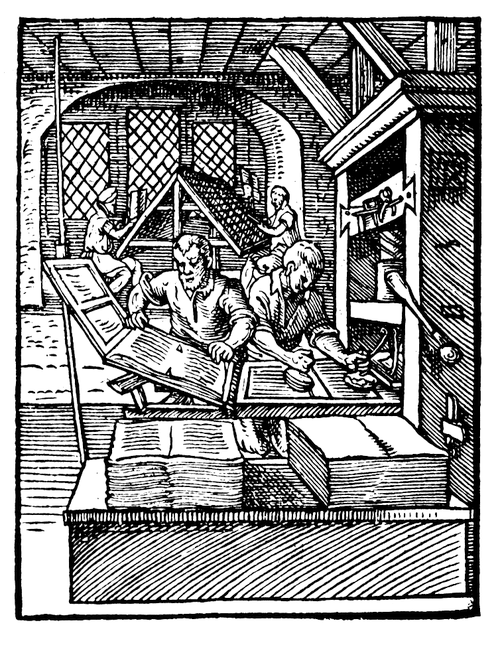
Jost Amman’s woodcut illustrations document a fully mature European printing workshop, compositors and pressmen working in tandem.
English literacy rises from roughly 30 percent to over 60 percent across more than 150 years, the gradual payoff of cheaper, more available print.
Log 01
What Gutenberg Actually Invented

Not the First, But the One That Scaled
It’s worth being precise here, because the popular version of this story tends to credit Gutenberg with inventing printing itself. He didn’t. Woodblock printing existed in China as far back as the 9th century, and Korean printers were casting movable metal type roughly a hundred years before Gutenberg got started in Mainz around 1440. What Gutenberg actually built was a specific, practical system: reusable metal type cast in a mold, an oil-based ink that adhered properly to metal rather than the water-based inks used for woodblocks, and a press mechanism adapted from wine and olive presses, engineered for speed and durability at a scale that made mass production of European-language texts commercially viable for the first time.
Before this, a single copy of a book represented weeks or months of a scribe’s labor, copying by hand onto vellum, with errors creeping into the text at every generation of copying. Books were, as a direct consequence, luxury objects, owned almost exclusively by monasteries, universities, and the very wealthy. Gutenberg’s system didn’t just make books cheaper. It made the concept of a “identical copy” possible at scale for the first time, a text that read the same in Mainz as it did in Paris.
Historians estimate around 180 copies of the Gutenberg Bible were originally printed, some on paper and some on the more expensive vellum. Roughly 49 copies, complete or partial, are known to survive today, scattered across libraries and collections worldwide, including the Library of Congress.
Log 02
The Book That Proved the Concept

Why This Particular Book Mattered
Gutenberg didn’t choose the Bible arbitrarily. It was the single text guaranteed to have buyers across every literate institution in Europe, the safest possible bet for a printer testing an enormously expensive new machine. The result, known today as the 42-line Bible for its column layout, was deliberately designed to resemble the finest hand-copied manuscripts of the era, right down to decorative initials added by hand after printing. Buyers weren’t meant to think of it as a cheap substitute. It was meant to look like exactly what it was: proof that a machine could match, and eventually exceed, what the best scribes in Europe could produce, at a fraction of the time and cost.
That proof of concept mattered more than the Bible’s specific content. Within decades, printing workshops had spread to major cities across Germany, Italy, France, and beyond, and the range of printed material expanded rapidly past religious texts into classical literature, scientific treatises, and eventually cheap political pamphlets, the format that would end up mattering most for what came next.
Log 03
The Slow Truth About Literacy
This is where the popular narrative needs correcting. It’s repeated constantly, in classrooms and casual retellings alike, that Gutenberg’s press “caused” a literacy explosion. The actual numbers tell a slower, more honest story. English literacy sat around 30 percent in the 1640s, nearly two hundred years after Gutenberg’s press began operating. It rose to roughly 47 percent by the 1690s, and reached about 62 percent only by 1800. That’s genuine, sustained growth, but it unfolded across more than fifteen decades, not the “sudden enlightenment” version of events that gets told for narrative convenience.
What did change quickly was availability and cost. Books that would have taken a scribe months to copy could now be produced by the hundreds in a fraction of that time, and the price dropped correspondingly. That’s a genuinely important shift. It just wasn’t the same thing as widespread literacy, which depended on separate, slower-moving factors: schools, economic incentive to read, and cultural norms around who was expected to learn. Print made literacy more achievable. It didn’t make it automatic.
Gutenberg’s printing press triggered an immediate, dramatic surge in European literacy, transforming an illiterate continent into a reading public within a generation.
English literacy climbed from roughly 30 percent in the 1640s to around 62 percent by 1800, a genuine but gradual rise spanning more than 150 years. What spread immediately was book availability and lower cost, not literacy itself, which depended on separate social and educational factors.
Log 04
What Actually Spread Overnight: Luther’s Theses

Why the Church Couldn’t Contain This One
Martin Luther nailed, or more likely just posted or circulated, his Ninety-Five Theses in 1517 as an academic invitation to debate, addressed to fellow scholars and clergy, written in Latin. That’s not how it ended up functioning. Within weeks, printers had translated and reprinted the theses as vernacular pamphlets, and they spread through German-speaking territories at a pace no single bishop, prince, or inquisitor could realistically intercept. Earlier reform movements, Jan Hus a century before Luther is the clearest example, had been suppressed by controlling the small number of manuscript copies and silencing the individuals who held them. That containment strategy assumed information moved as slowly as a single messenger or a handful of hand-copied texts.
Print broke that assumption completely. An idea, once typeset, could be reproduced by any printer with access to a press, in any city, faster than any authority could track down and destroy every copy. This is the part of the printing press story that mattered instantly, not gradually: it changed who got to decide whether an idea survived. Previously, that decision sat with whoever controlled physical access to the few existing copies. After Gutenberg, no single person or institution held that leverage anymore.
“Movements could now be organized by leaders who had no physical contact with their followers.”
World History Encyclopedia, on the consequences of printLog 05
The Print Shop Becomes Infrastructure
From Gutenberg’s Workshop to a Continental Industry
By the time Jost Amman documented a working print shop in 1568, the technology had matured from Gutenberg’s original experimental workshop into a standardized industrial process. Compositors set individual metal letters into frames, one line at a time; pressmen operated the mechanical press itself; and the division of labor mirrored, in miniature, the kind of specialized production line that wouldn’t become common in other industries for centuries. This wasn’t a single inventor’s workshop anymore. It was infrastructure, replicated across hundreds of European cities, each shop capable of producing its own local editions of texts that could originate anywhere on the continent.
That standardization is part of why the printing press gets compared, reasonably, to later general-purpose technologies. It didn’t just do one thing well. It created a repeatable production system that any city with enough capital and a trained crew could stand up, which is exactly the kind of infrastructure that turns an invention into a civilizational shift rather than a curiosity.
| Effect | Speed of Change | Evidence |
|---|---|---|
| Book Cost & Availability | Nearly immediate | Print shops multiplied across Europe within decades of the 1450s |
| Suppression of Dissenting Ideas | Immediate structural shift | Luther’s theses spread as pamphlets within weeks, outrunning containment |
| Literacy Rates | Gradual, over 150+ years | English literacy: ~30% (1640s) → ~47% (1690s) → ~62% (1800) |
| Standardized Print Industry | Roughly a century | Documented specialized print-shop roles by Amman’s 1568 illustrations |
Conclusion
The Actual Mechanism of Change
The printing press didn’t create readers out of nowhere, and it’s worth resisting the version of history that says it did. What it created, right away, was a distribution system that no single authority could fully control, and a manufacturing process durable enough that ideas, once printed, tended to survive somewhere even when powerful people badly wanted them destroyed. Literacy caught up eventually, slowly, across generations, driven by schools and economic incentive as much as by the existence of cheap books. The press didn’t do that work by itself. What it did do was remove the physical bottleneck that had let a small number of institutions decide, by controlling scarce manuscripts, which ideas got to exist at all.
Explore the Forensic Archives
Core Scholarship
- Eisenstein, Elizabeth L. (1979). The Printing Press as an Agent of Change. Cambridge University Press. Foundational study connecting print standardization to the Renaissance and Reformation.
- World History Encyclopedia. “The Printing Revolution in Renaissance Europe.” Survey of documented consequences including vernacular standardization and movement organization.
Literacy Data
- Schlossberg, Tatiana. “The State of Publishing: Literacy Rates.” Historical English literacy statistics, 1640s–1800.
- Denver Center for the Performing Arts, Research Notes. Contextual data on 15th-century European literacy prior to Gutenberg.
Reformation & Print Distribution
- Amman, Jost (1568). Woodcut illustrations documenting standardized European print-shop operations.
- Gutenberg Bible census records, various institutional holdings including the Library of Congress. Survival and print-run estimates.
System Index