Infrastructure History Hidden Systems
14 Minute Read
Why Addresses Have Numbers:
The Hidden System That
Organized Modern Life
Before house numbers existed, finding someone’s home meant knowing their trade, their neighbors,
and the sign above their door. Then governments discovered they needed to find everyone at once.
The administrative project behind your front door is older, stranger, and more consequential than most people realize.

34 Park Vista, Greenwich, April 2023. House numbers are so ordinary that most people never consider the centuries of military planning, administrative reform, and tax administration required to create them. Image: Public Domain.
Consider what it takes to direct someone to your front door without a number. Not to your neighborhood. Not to your street. To your specific building, among dozens of identical facades sharing the same lane. You would say: take the road past St. Bride’s church, turn where the old tannery used to be, find the house with the green shutter on the left. That description assumes the visitor already knows which St. Bride’s, roughly where the tannery stood before it burned, and which way is left. For centuries, cities functioned on exactly this kind of knowledge. Then governments decided they needed to find everyone, all at once.
01 / 09 The Problem
The Problem Before Addresses
For most of European urban history, the building you occupied was identified by its owner, its trade, or a painted sign above the entrance. The sign of the golden fleece. The sign of the three compasses. The red lion. These signs did more than advertise goods. They functioned as the address. A tradesman giving directions to a merchant from another city would say: find the lane where the cloth sellers work, look for the house with the owl carved above the lintel.
Streets carried this same logic into their names. London’s Bread Street ran alongside the medieval bread market. Cheapside took its name from the Old English ceap, meaning trade. Vienna’s Bäckerstrasse was simply the baker’s street. Paris had its rue des Bouchers, the street of the butchers. Every major European city organized its geography around the trades and institutions that occupied it. The names were not decorative. They were navigational.
Individual buildings had no assigned numbers. The baker at the north end of Bread Street and the baker at the south end were both “the baker on Bread Street.” Distinguishing between them required proximity knowledge. A local resident knew which one you meant. A stranger from another city had no reliable way to find out.
At relatively modest urban scales, this was manageable. Most inhabitants spent most of their lives within a few blocks. Government administration was local and personal. A tax assessor knew the properties in his ward. A letter addressed to “Mr. Thomas Harrison, glover, near the guildhall, York” would reach a postal carrier who knew the town well enough to deliver it through personal inquiry.
The system began to fail as cities grew past roughly fifty thousand inhabitants and as institutions began demanding something more precise than social memory. Insurance companies mapping fire damage after London’s conflagration of 1666 could not produce systematic damage records because they had no systematic building references. Military conscription across the Habsburg Empire required tracking individuals who had no fixed administrative label beyond their name and a neighborhood description. Tax authorities attempting to identify untaxed properties in rapidly expanding Paris had no framework for cataloguing what they found.
The sign-and-landmark system worked well in cities under about 30,000 people, where social networks overlapped enough that local knowledge was reliable. Once cities passed this threshold, the same sign names began repeating across different neighborhoods. Multiple taverns called themselves the Red Lion. Several trades shared the same district. The personal knowledge that made the system work began to degrade faster than it could be maintained.
Something more permanent, more abstract, and more administratively legible was needed. The solution, when it arrived, was not invented by a city planner trying to help visitors navigate. It came from a general trying to conscript an army.
02 / 09 Pre-Address Navigation
How Cities Worked Without Numbers
The medieval view of Erfurt below shows, better than any written description, what pre-address urban navigation looked like in practice. The city presents as a dense network of churches, guild halls, markets, and residential lanes, each identifiable by its function or its dominant institution, none of it organized around any systematic numbering logic.
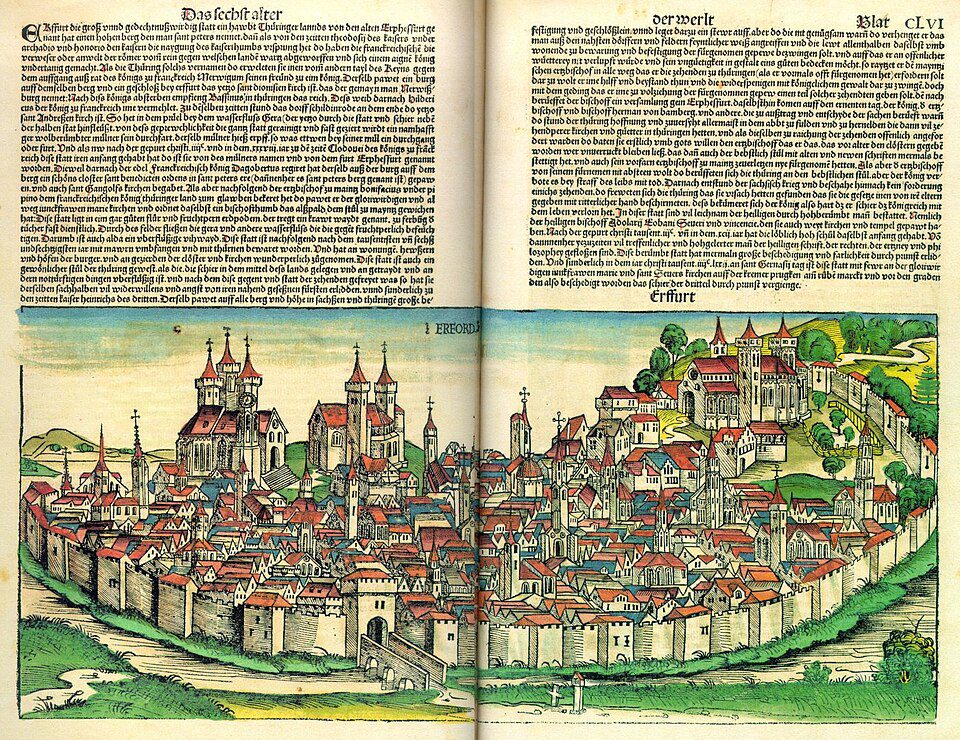
Navigation in a city like this worked through layered social knowledge. A merchant directing a visitor to his warehouse did not rely on numbers. He relied on shared reference points: the cloth hall on the main square, the lane that runs east past the Augustinian friars, the building with the carved stone fish above the door. This approach had an important property. It was self-maintaining. As long as the same landmarks occupied the same positions, the directions stayed valid. The stone fish above a doorway changed meaning only if the owner changed the carving.
What made the system work was social density. In a city where most inhabitants rarely traveled more than a few blocks from their regular routes, the reference network was memorized. Directions could be given in seconds by anyone on the street. The landmarks were not formally documented anywhere. They existed in collective urban memory.
This is where the system becomes interesting. The same density that made landmark navigation reliable also created the condition that would eventually destroy it. As cities grew, new neighborhoods formed beyond the range of existing landmarks. New arrivals knew neither the old reference points nor the newer ones. The postal challenge was particularly stark. Henry Bishop, appointed England’s first Postmaster General in 1660, introduced the first postmark not to help recipients track letters but to verify that post boys were not delaying delivery. Letters were still being routed through personal inquiry by carriers who knew their areas.
By the early eighteenth century, London’s commercial correspondence had grown past any reasonable expectation that personal inquiry could handle it. A letter addressed to “Mr. John Harris, linen draper, near the Exchange” might reach someone in the City of London who knew the general area and could narrow it down from there. Or it might not. The unreliability was understood by everyone who used the system and accepted as a fact of urban life.
What changed the calculation was not a breakthrough in navigation technology. It was the realization, by several European states nearly simultaneously, that governments needed to do something much more demanding than deliver letters. They needed to count buildings.
03 / 09 The Invention
Who Invented Numbered Addresses
The first large-scale, systematic building numbering in Europe was not driven by postal efficiency, urban planning, or any desire to help strangers navigate cities. It was a military problem that produced it.
In 1770, the Habsburg administration under Empress Maria Theresa faced a persistent challenge: how to systematically conscript, quarter, and track soldiers across a vast, fragmented territorial empire. Knowing that a regiment needed to be raised from a specific province was straightforward. Knowing exactly which buildings in a specific town could be requisitioned for quartering was not. There was no systematic building inventory. Local officers relied on personal knowledge that was neither standardized nor transferable.
The Conscription Ordinance of 1770-1771, issued across the Bohemian and Austrian territories, required a solution. Survey teams moved through towns and villages in an assigned walking sequence, marking a number on the wall or door frame of each building as they passed. The number recorded the order of survey, not any position on a street. The result was a numbering system that, to any visitor without the survey map, appeared completely arbitrary. Building 12 might stand between buildings 47 and 3 because the surveyor had turned a corner and doubled back along a different lane. The numbers meant nothing navigationally.
They meant a great deal administratively. A military register that recorded “conscript Johann Weber, residing at house number 214 in the district of Leopoldstadt” conveyed no information to a stranger about where on Leopoldstadt’s streets number 214 stood. But to the district officer holding the survey map, it pointed unambiguously to a specific building. For the first time, the Habsburg state possessed a fixed, persistent label for every building in its territory.
Austrian historian Anton Tantner, whose academic work on the history of house numbering in Europe is the principal scholarly reference for this period, documented the Vienna survey records extensively. His research established that the Habsburg numbering was explicitly administrative rather than navigational in design, and that its spatial logic was opaque by intention — the government needed a reference code, not a visitor’s guide.
Paris arrived at a different solution through a different crisis. The French Revolutionary reorganization of administrative geography, which abolished the old provinces and created the département system in 1790, required a corresponding reform of urban addressing. The definitive Parisian system came by imperial decree in 1805: buildings would be numbered sequentially along each street, odd numbers on one side, even on the other. Streets running parallel to the Seine would count from east to west, following the direction of the river’s current. Streets running toward the river would count from the bank outward, ascending as you walked away from the water.
This logic is still in use in Paris today. The address number alone tells you, if you know the system, roughly where on the street you are and which direction you face relative to the Seine. That is navigation, not just administration. It was a genuinely different design philosophy from Vienna’s walking-sequence model, and it produced addresses that residents could actually use to find places.
The distinction matters more than it might seem. Vienna’s system was built for the state to find citizens. Paris’s system was built so that citizens could find each other. Modern urban addressing inherits both traditions.
If you are tracking how ancient measurement networks operate as modern firmware, this investigation maps the railroad logistics that standardized global time.
04 / 09 State Administration
Taxation, Property, and the State’s Need to Find You

The map above looks, at first examination, like a property record. Parcels are measured, labeled, and precisely coded. Boundary lines divide fields and structures with geometric accuracy. It is systematic, detailed, and methodical.
It is a property record. But it is also the administrative foundation on which modern house numbering was built, and understanding why requires following the logic of government rather than the logic of navigation.
Napoleon’s cadastral decree of September 15, 1807, ordered a complete, parcel-by-parcel survey of France. The immediate motivation was taxation. The tax system under the ancien régime had been chaotic at best: different regions applied different rates to differently defined property categories, with widespread evasion enabled by the simple absence of accurate records. An assessor who could not identify exactly which building stood on exactly which parcel of land could not reliably tax it. A systematic survey that measured every parcel and documented every building’s location would transform tax assessment from an approximate art into a documentable practice.
The survey took decades. When it was complete, France possessed something no state had previously held: a documented record of every building, its location, its owner, and its assessed value. The cadastre was not an address system in the navigational sense. It was an identification system. But it made the navigational address system economically and politically inevitable.
Once the state knows precisely where your building is, it eventually needs a standard way to refer to it in correspondence. Tax notices, census forms, military summons, insurance records, legal documents: all of these required a label that could be understood by a stranger who had never visited the property. The building number graduated from a survey reference code into an address.
The same dynamic played out independently in Prussia during the early nineteenth century, and in Britain somewhat later. London’s Metropolitan Management Act of 1855 gave local boards explicit authority to number and rename streets — a formal recognition that the patchwork of house numbering that had developed unevenly across the city over the previous century needed standardization. The immediate pressure was not military conscription or cadastral taxation. It was the expansion of gas and water utilities, which required sending engineers to specific buildings for connection and repair. Without unambiguous building references, utility companies could not operate at scale.
The thread connecting Vienna’s military survey, Napoleon’s cadastre, and London’s utility legislation is identical. Each represents the moment when the scale of state administration or commercial operation exceeded what social memory could support. Numbers were the cheapest possible identifier, the easiest to assign, and the most resistant to ambiguity. Once a building had a number, that number could appear on a register, a map, a letter, and a utility invoice, all referring to the same physical structure without any confusion about which building was meant.
That simplicity was the entire point.
05 / 09 The Mathematics
The Mathematics of Addressing
Once cities committed to systematic numbering, a secondary question emerged that has no obviously correct answer: how should those numbers run? The range of solutions that different cities arrived at is more revealing than it might seem. It shows how much administrative priority shapes what looks, from the outside, like a neutral technical decision.
The most common European approach assigns odd numbers to one side of a street and even numbers to the other. This seems like a minor convenience. In practice, it encodes navigational information into the address itself. If you are heading to number 47, you know before you arrive that your destination is on the odd-numbered side. You can cross to the right side of the street at the corner and walk without looking at both sides simultaneously. An address of 47 and 48 are across the street from each other. An address of 47 and 49 are next-door neighbors. The structure tells you which direction to walk and where to look.
The directionality of numbering adds another layer. Paris numbers streets parallel to the Seine from east to west, counting from the river outward for cross-streets. Stand anywhere in Paris with an address in hand, and the number alone tells you your orientation relative to the river and your position on the street. That detail changed everything for postal workers, delivery carriers, and anyone navigating an unfamiliar arrondissement.
American grid cities added a further refinement. In cities planned on a regular grid — Philadelphia, Chicago, most of the American Midwest — addresses are assigned in blocks of one hundred. Addresses 100 through 199 occupy the first block from the reference point, 200 through 299 the second. This means that an address number alone carries distance information. A delivery driver knows that 1750 Michigan Avenue is seventeen and a half blocks from the origin of numbering, wherever that happens to be. An address gives a rough travel time estimate before the journey begins.
“The address number was never just a label. In a well-designed system, it encodes the building’s position in relation to the entire city.”
Synthesis of Reuben Rose-Redwood, “Governing the World at a Distance,” Transactions of the IBG, 2010What makes this mathematically elegant is that the information was never an explicit design goal. It emerged as a natural consequence of assigning numbers consistently along a known direction. The early municipal officials who established these systems were thinking about tax rolls and military registers, not spatial information theory. The navigational value was an unintended consequence of administrative consistency.
06 / 09 System Design
Sequential vs Grid-Based Systems

The Commissioners’ Plan for Manhattan, published in 1811, looks from a modern perspective like an act of confidence in geometry. The three commissioners appointed to plan the city’s future growth — Gouverneur Morris, Simeon De Witt, and John Rutherford, with surveyor John Randel Jr. doing most of the ground measurement — imposed a grid of twelve numbered avenues and 155 numbered streets across most of the island’s length. The grid ignored terrain, existing roads, and the preferences of landowners along the route. The reasoning, stated explicitly in the commissioners’ report, was that a rectangular plan was the most efficient possible form for building on land, and efficiency was the priority.
This is the grid address system, and it works fundamentally differently from the European sequential model. In a grid system, a building’s address is its grid coordinates: the number of the cross street, and the block position along the avenue. The address carries mathematical precision. It tells you, without a map, approximately where in the city you are standing.
European sequential systems work differently, and not worse. In a sequential system, buildings are numbered in walking order along each street: odd numbers on one side, even on the other, ascending from one end toward the other. The numbers reflect street position but give no information about the street’s position in the city as a whole. You know you are heading toward the high numbers on your street. You do not know which direction that takes you in the broader urban fabric unless you already know the street.
Japan developed a third approach that neither European nor American visitors find intuitive. Japanese urban addressing is organized around blocks called chōme rather than streets. Within a block, buildings are numbered in the order they were officially registered, which generally follows the order in which they were constructed. Building 7 in a block might sit between buildings 12 and 3 because it was registered seventh, its neighbor twelfth, and its other neighbor third. For someone who expects sequential numbering along a path, this is disorienting. For a resident who navigates by block identity and knows the area personally, it works precisely because Japanese urban navigation was historically organized around blocks as units, not street frontage.
The differences between the American grid, European sequential, and Japanese block systems are not accidents or arbitrary cultural preferences. Each reflects the administrative priority that generated it. American grid addressing prioritized efficient urban development and standardized land transfer. European sequential systems prioritized postal delivery along carrier routes. Japanese block systems prioritized land registry and legal ownership records. Each system is optimal for what it was designed to do, and mildly impractical for all other uses.
What these systems share is more important than what separates them. Each represents a commitment to persistent, unambiguous building identification. Once a building has a number in any of these systems, that number can appear on a tax register, a military call-up paper, a court summons, a utility connection, or a delivery manifest, and everyone who reads it will know which building is meant. That was the entire point from the beginning.
Archive Members get clean reading, direct delivery, and downloadable PDF editions of every investigation.
Before and After: The Practical Difference House Numbers Made
| Practical Need | Before House Numbers | After House Numbers |
|---|---|---|
| Delivering a letter | Carrier asks locals; uncertain in unfamiliar areas | Sorted by number, routable without local knowledge |
| Emergency response | Landmark description; imprecise, misinterpretable | GPS-routable to exact building, dispatchable instantly |
| Property taxation | Narrative survey descriptions, outdated on ownership change | Cadastral number, unambiguous, permanent identifier |
| Military conscription | Village-level headcounts; individuals lost in city complexity | Individual building assignment, cross-referenced with registers |
| Census operations | Door-to-door with local guides, overlaps and gaps common | Systematic by address range, completeness verifiable |
| Receiving parcels | Name recognition, limited to those known locally | Automated last-mile routing, strangers can deliver |
07 / 09 Postal to Emergency
Postal Systems and Emergency Lines
The Penny Post, introduced in Britain on January 10, 1840, changed the relationship between addresses and daily life more profoundly than any postal reform before it. Before 1840, postage was collected from recipients on delivery, at rates that varied by distance and sheet count. Most people rarely used the postal system. After 1840, a uniform penny rate, prepaid by the sender using an adhesive stamp, made letter writing accessible to the general population for the first time.
The volume consequence was immediate and dramatic. The British postal system delivered roughly 76 million letters in 1839. By 1850, that figure had risen past 350 million. Sorting that volume at speed required something the old system had never needed: an address legible to a stranger. A letter to “Mr. Thomas Brown, near the market square, Sheffield” still required a Sheffield sorter to identify the market square from personal knowledge and estimate a carrier route from there. A letter to “14 Market Street, Sheffield” could be sorted by anyone who could read a number.
The General Post Office’s sustained pressure on municipalities throughout the Victorian period to standardize house numbering was persistent and largely effective. By 1900, most British cities had comprehensive, consistent street numbering. Rural addressing remained genuinely difficult, a problem Britain eventually addressed through the postcode system, with experimental use beginning in Norwich in 1959 and nationwide implementation completed by 1974.
The United States solved its equivalent challenge differently. The Zone Improvement Plan codes, launched July 1, 1963, appended a five-digit number to every US address. The first digit identified a broad national region, subsequent digits narrowed to city and local delivery zone. The ZIP code made machine sorting possible at postal processing centers and remains one of the most consequential administrative infrastructure decisions of the postwar era, since it is now embedded in everything from property valuations to credit scoring models.
Emergency services completed the transformation. After a 1967 presidential commission on law enforcement recommended a unified emergency number for the United States, the 911 system was designed around a simple premise: a call for help must be routable to a specific address. The first 911 call in the country was placed on February 16, 1968, in Haleyville, Alabama. The dispatcher receiving it needed a building number to send help. Without a functioning address system, the system does not work.
This is not an abstract vulnerability. When the 2010 earthquake hit Haiti, rescue operations were disrupted in part because Port-au-Prince lacked consistent urban address systems. Neighborhoods that had grown informally over decades had local naming conventions that outsiders could not decode. International rescue workers were forced to coordinate by GPS coordinates and neighborhood names rather than street addresses, adding time and uncertainty to operations where both were in short supply. The invisible infrastructure of addressing became visible precisely when it was absent.
08 / 09 Failure Modes
Failures and Addressing Chaos
Address systems seem inevitable only from inside one. For hundreds of millions of people, they have never existed in any consistent form, and for billions more, the official address is largely theoretical: it appears on a government register somewhere and is never used in practice because neither the postal system nor emergency services can act on it reliably.
The UN-Habitat programme estimates that approximately four billion people worldwide lack a formal address. The figure is an estimate, and estimates in this area are uncertain in their precision. The scale, however, is not seriously disputed. Informal settlements in Lagos, Dhaka, Cairo, and across sub-Saharan Africa and South Asia have grown faster than any municipal addressing effort could follow. Streets in these areas carry informal names known to long-term residents. Individual buildings have no official numbers. Delivery requires relationship networks and locally acquired knowledge rather than systematic routing.
The practical consequences reach further than inconvenience. Healthcare systems in unaddressed areas cannot reliably conduct home visits. Utility companies cannot connect services to buildings they cannot locate in their administrative records. Legal property ownership is difficult to establish without an address that appears in municipal files. Financial services, including banking, insurance, and credit, typically require a verifiable address as a precondition for access, meaning that unaddressed populations are structurally excluded from formal financial systems regardless of their economic activity.
“Ireland — a member of the European Union with a developed urban infrastructure — did not complete a national postcode system until 2015. The last rural addresses were assigned less than a decade ago.”
Eircode project documentation, An Post, Ireland, 2015Ireland presented an unusual case study in the developed world. As recently as 2015, Ireland was one of the last countries in Europe without a national postcode system. Rural addressing in parts of the country had remained genuinely vague for decades. Properties were described by reference to townlands (ancient Irish administrative units not mapped to postal coordinates) and by local naming conventions that varied across county boundaries. Emergency services dispatched to rural addresses occasionally relied on the caller staying on the line to provide spoken directions.
Eircode, introduced in August 2015, assigned a seven-character alphanumeric code to every address in the country, including individual rural properties that had never previously been distinguishable by address alone. The project required surveying approximately 2.2 million addresses and represented the first time many rural properties had a unique, externally legible identifier. In Europe, that milestone was reached less than ten years ago.
Technology has attempted to bridge the gap in areas where formal addressing has not arrived. What3Words, founded in 2013, divided the world into three-meter by three-meter squares and assigned each a unique combination of three words. The system has been adopted by emergency services in several countries and is used by logistics companies working in areas without formal addresses. It solves the navigation problem. It does not create the administrative infrastructure that a formal address provides: the permanent, government-legible link between a location and a documented resident, owner, or taxpayer.
Why the Number on Your Door Still Matters
Your street address connects you to systems of administration most people never consciously engage with. Electoral rolls, tax records, insurance policies, bank accounts, credit assessments, emergency dispatch, parcel delivery, census enumeration, voter registration, immigration records: each of these institutions locates you through the number affixed to your door.
This is so ordinary that it requires an effort to notice. When you complete a form that asks for your address, you do not feel you are participating in an administrative system inherited from an eighteenth-century Austrian military census and a nineteenth-century French property survey. You are simply filling in your address.
What is worth noticing is the scale of what that normality represents. The state’s ability to find you, to deliver services, to tax you, to call you for jury duty, to send emergency assistance when you need it, rests entirely on the persistence of a four-digit number on a wall that someone assigned to your building following a logic devised before your grandparents were born.
The billions of people living without formal addresses today are not an anomaly in a world that has otherwise solved the problem. They are evidence that address infrastructure was never a natural feature of cities. It was built, gradually and unevenly, by governments pursuing military, fiscal, and administrative goals that had little to do with the convenience of the people being counted. Where those governments did not reach, or where they reached and then withdrew or collapsed, the infrastructure did not form.
In 1770, Austrian surveyors walked through Vienna marking numbers on doorframes so that the imperial army could locate its conscripts. By 2025, the descendant of that administrative act underpins same-day parcel delivery, democratic participation, and the practical possibility of calling for an ambulance with any realistic expectation of it arriving in time.
The logic of the 1770 Habsburg survey runs through every digital mapping system in use today. Google Maps routing, Amazon last-mile delivery, and Uber pickup coordination all depend on standardized address data maintained by the same municipal registries whose design principles trace back to the Napoleonic cadastre and Victorian postal standardization. The technology has changed entirely. The underlying problem is identical: how to locate a specific building among thousands, reliably, without local knowledge. Every time a delivery algorithm resolves your postcode to a coordinate, it is executing a version of what an Austrian survey team did on foot in Bohemia in 1771.
Every number on every door is a record of a government that, at some point in the last two centuries, decided it needed to know exactly where you live.
10 / 10 FAQ
Frequently Asked Questions
Q Who invented house numbers?
No single person invented house numbers. The first large-scale, systematic building numbering was carried out under the Habsburg Conscription Ordinance of 1770–1771, ordered during the reign of Empress Maria Theresa of Austria. Survey teams assigned numbers to buildings in the order they were visited during the survey, across Bohemian and Austrian territories. The purpose was military conscription, not postal delivery or navigation. Paris independently developed its systematic street-based numbering by imperial decree in 1805. Different cities and states arrived at similar solutions through similar administrative pressures within roughly the same half-century.
Q Why are house numbers odd on one side and even on the other?
The odd-even convention was adopted in many European cities, including Paris under the 1805 decree, to encode navigational information in the address itself. If you know you are heading to an odd-numbered building, you can cross to the appropriate side of the street before you begin walking, rather than checking both sides as you go. It also means that two consecutive odd numbers — say, 47 and 49 — are neighboring buildings, while 47 and 48 are directly across the street from each other. The system compresses positional information into the number itself.
Q When did the United States start using house numbers?
American cities adopted house numbering at different times and with different approaches. Philadelphia was laid out on a numbered street grid by surveyor Thomas Holme in 1682 for William Penn, making it one of the earliest planned American cities with a grid address framework. New York’s Commissioners’ Plan of 1811 established the numbered avenue-and-street grid that still defines Manhattan. The assignment of specific building numbers within blocks developed more gradually through the nineteenth century alongside postal expansion, utility installation, and the general growth of municipal administration.
Q What did people do before house numbers existed?
Before systematic house numbering, buildings were identified by painted signs, the owner’s name, the trade practiced there, or proximity to a known landmark. Finding a specific building required either local knowledge or asking someone who had it. Streets were named for the trades concentrated on them. For familiar addresses within a community, this worked reliably. For strangers navigating an unfamiliar city, or for institutions trying to manage large urban populations systematically, it was frequently insufficient. The postal system, in particular, relied on carriers who knew their local areas personally.
Q How does Japan’s addressing system work?
Japan uses a block-based system rather than a street-based one. Addresses identify a city, ward, district, and chōme (neighborhood block), followed by a block number and a building number within the block. Building numbers within a block are assigned in the order the buildings were officially registered, which generally follows the order they were constructed. This means that sequentially numbered buildings are not physically adjacent — they were simply registered at similar times. The system reflects a land registry priority rather than a navigation priority, and works best for people who navigate by block identity and local knowledge rather than sequential street numbering.
Q Why do some countries still lack formal address systems?
Address infrastructure is built and maintained by governments, and where government capacity has been limited, unstable, or absent, formal addressing has not developed systematically. Informal settlements that grow faster than municipal administration can follow them tend to develop their own local naming conventions that are legible to residents but not to outsiders. The consequences include limited access to formal financial services (which require a verifiable address), difficulty receiving healthcare or utility connections, and compromised emergency response. The UN-Habitat programme estimates roughly four billion people currently lack a formal address.
Q What is the connection between Napoleonic cadastral surveys and modern addresses?
Napoleon’s cadastral decree of September 15, 1807, ordered a parcel-by-parcel survey of all land in France. The primary motivation was tax reform: a reliable property record made assessment accurate and legally defensible. Once every building had been measured and documented in the cadastral system, the state possessed a complete inventory of built property. Any correspondence referencing a specific property — tax notices, census forms, legal documents — required a standardized identifier for that building. The cadastral survey created the administrative infrastructure from which systematic addressing became not just useful but structurally necessary.
Q When was the 911 emergency number system introduced?
The US 911 emergency number was recommended by the President’s Commission on Law Enforcement in 1967. The first 911 call in the United States was placed on February 16, 1968, in Haleyville, Alabama. The system depends entirely on address infrastructure: a dispatcher who receives a 911 call needs a precise building address to route emergency services. The UK’s equivalent, 999, was established considerably earlier, on June 30, 1937, and faced similar address dependency. The effectiveness of emergency response is structurally tied to the quality of address systems in the areas served.
— Sources
Sources and Further Reading
Primary texts, academic scholarship, and institutional records supporting the claims in this article. Where historians disagree or evidence is uncertain, the uncertainty is noted in the text.
Related investigations from The Historical Insights
Address systems are one of many invisible administrative frameworks inherited from decisions made centuries ago.