

Maritime Archaeology Provenance & Valuation
The Most Valuable Artifacts Ever Recovered From Shipwrecks
Twenty objects raised from the seabed, each one shaped by the same four forces in different proportions: a disaster that put it there, a recovery that brought it back, a chain of ownership that can be traced, and a market or court that eventually had to decide what it was worth.

Most valuable objects have a fairly linear history. Someone makes them, someone owns them, and eventually someone sells them. Shipwreck artifacts break that pattern in the middle. Between manufacture and market sits a gap that can run from a single night to twenty-one centuries. During this time, the object does nothing at all except survive, or fail to. The historical and financial record indicates that this gap is where almost all of the value in this list actually originates.
A pocket watch stopped at 2:20 a.m. is worth vastly more than an identical watch that kept running. The metal did not change, but the stopping is evidence. A bronze statue thrown overboard by looters two thousand years ago is worth more intact today than it would have been sold whole in antiquity. Its disappearance is what let it skip the melting pot that consumed almost every other large-scale Greek bronze. The twenty objects below were recovered from a Titanic corpse, a pirate galley, a Roman transport ship, a Tudor warship, and half a dozen other wrecks. They span roughly 3,300 years of maritime disaster. I have tried to keep three things separate throughout: what the object is, how it survived, and what kind of figure actually attaches to it. That figure could be a completed sale, a court’s admiralty valuation, an insurance indemnity, or simply “not for sale at any price”.
This final distinction carries significant legal and historical weight. A great many shipwreck valuations circulating online quietly convert an insurance figure or a legal estimate into something that reads like an auction result. This flattens a genuinely significant distinction between commerce, custody, and heritage. I have avoided doing that here. Where the dossier behind a figure is thin or contested, I have said so rather than smoothing it over.
Classical Antiquity’s Bronze Survivors

Victorious Youth (“The Getty Bronze”)
The statue depicts an adolescent athlete. He is nude and reaches up to place an olive wreath on his own head. This victor’s gesture identifies him as a champion at one of the Panhellenic games. He is attributed to the circle of Lysippos, the court sculptor to Alexander the Great. Both feet are missing below the ankle. They were pried off their original marble base sometime in antiquity before the statue was loaded onto a Roman ship crossing the Adriatic, along with an unknown quantity of other plundered Greek statuary.
That ship never completed its voyage. The bronze lay on the seabed for roughly two thousand years. In the summer of 1964, an Italian fishing trawler, the Ferruccio Ferri, snagged it in its nets in international waters off Fano. The crew brought it ashore and hid it in a local priest’s garage. It was smuggled into Northern Europe before resurfacing on the Munich art market in 1977, where the J. Paul Getty Trust bought it for $3,950,000.
The legal afterlife of this purchase illustrates the complexities of international heritage law. Italian prosecutors have argued for decades that the statue was found in Italian territorial waters and illegally exported. On May 2, 2024, the European Court of Human Rights dismissed the Getty Trust’s application challenging an Italian judicial forfeiture order. This ruling upheld Italy’s claim without actually resolving who has physical custody of the bronze. Fifty years after the purchase, the most basic question about a $3.95 million acquisition remains legally unsettled.
The ECHR’s 2024 ruling is a jurisdictional decision, not a repossession order. It confirms Italy’s forfeiture claim is enforceable under Italian law but does not itself compel the Getty to surrender the statue, leaving the practical outcome dependent on further diplomatic and legal proceedings.

The Riace Bronzes: Statua A
Statua A and Statua B are two life-sized bronze warriors. Cast in Greece around 460–430 BCE, they feature copper-inlaid lips, silver teeth, and bone-and-glass eyes. Scholars have floated attributions to Phidias, Ageladas, and Alkamenes without settling on one. They were loaded, along with other statuary, onto a Roman transport ship crossing the Ionian Sea and never made it to their destination.
They were found almost by accident. On August 16, 1972, a recreational diver named Stefano Mariottini was swimming off Marina di Riace, Calabria, at a depth of about 25 feet. He noticed what he first assumed was a body. It was Statua A’s arm. The Carabinieri’s diving unit recovered both statues. Metallurgical sampling later showed something the naked eye cannot detect. The clay core inside Statua A matches deposits from Argos. Statua B’s core is consistent with Attica. This is proof the two figures were cast in different regional workshops decades apart from each other.
Neither statue has ever been sold. Both are held as non-monetized state patrimony in the Museo Nazionale della Magna Grecia in Reggio Calabria. The €300 million figure that circulates in press coverage is an insurance indemnity. It is the sum Italy’s Ministry of Culture would need to be made whole if the statues were destroyed or lost during an exhibition loan. It is not a market price.

The Riace Bronzes: Statua B
Statue B was originally cast wearing a Corinthian-style helmet pushed back on the head. It shows visible signs of ancient repair. A patched section on the right shoulder suggests Roman-era or later restorers intervened before the statue ever went into the sea. This indicates it was already an old and valued object by the time it was loaded as cargo. Where Statua A reads as youthful and idealized, Statua B has a heavier, more weathered face. Some scholars read the pair as a matched set depicting different life stages of the same heroic type rather than two unrelated commissions.
An accident of transport can obscure profound differences in origin. They surfaced from the same patch of seabed on the same afternoon, which invites treating them as a pair. However, the clay-core analysis makes clear they were made in different cities, probably decades apart, by different hands. They only came together because a Roman collector or looter happened to acquire both for the same shipment. The wreck that carried them has never been located. Archaeologists remain divided on whether the vessel sank in a storm that scattered the statues, or whether it settled intact and still lies buried somewhere nearby.
Almost no life-sized Greek bronzes survive from antiquity because bronze was routinely melted down for coinage or weapons in later centuries. Submersion is the main reason any of the classical bronzes in this feature exist at all. Sinking removed them from that recycling cycle entirely.

The Artemision Bronze
The statue shows a bearded, muscular god mid-stride. His weight is balanced on his left leg, and his right arm is cocked back to throw something. That missing object was never recovered with him and has never been identified with certainty. If it was a thunderbolt, he is Zeus. If a trident, he is Poseidon. Both attributes fit the pose equally well, and the debate has never fully resolved. The empty eye sockets were once inlaid with bone. The silver eyebrows and copper lips and nipples would have made the bronze startlingly lifelike in its original polychrome state.
He was found in fragments off Cape Artemision on the northern coast of Euboea. The site was first located in 1926 and properly excavated in 1928 from a shipwreck context dated to around the 2nd century BCE. The statue itself was cast roughly three centuries earlier during the Early Classical Severe Style period. It was already an antique when it was loaded as cargo. Most likely, it was looted Greek statuary bound for Rome. This is the exact pattern that put other major classical bronzes on the seabed.
Unlike pieces sold at auction, no market transaction attaches to this statue at any point in its documented history. It has always belonged to the Greek state and sits today in the National Archaeological Museum of Athens as an inalienable piece of cultural patrimony. Its 1928 recovery proved that intact, monumental ancient sculpture could still be sitting on the Aegean seabed. This helped justify the systematic underwater surveys that would soon recover other ancient masterpieces.

The Antikythera Mechanism
Inside a shapeless, corroded lump of bronze pulled from the Antikythera wreck sat at least thirty interlocking gear wheels. They were arranged with a precision that has no known parallel for another thousand years of technological history. Micro-focus CT scanning showed that the gear train modeled the synodic cycles of the sun and moon, predicted eclipses using a 223-month Saros cycle, and tracked the four-year calendar of the ancient Olympic Games. It is a mechanical calculator built between 150 and 60 BCE.
Greek sponge divers from the island of Symi found the wreck in the spring of 1901. The mechanism itself sat unrecognized among the recovered bronze fragments for almost a year. The archaeologist Valerios Stais finally noticed a gear wheel embedded in one of the calcified blocks in May 1902. The timeline of the object’s comprehension is striking, spanning decades after its physical recovery. It was most recently clarified through 21st-century imaging technology its Roman-era owner could never have imagined would exist.
The mechanism carries no market price. It is held as inalienable Greek state patrimony in the National Archaeological Museum of Athens. Debate continues over where it was built. The astronomical school of Hipparchus on Rhodes is the leading candidate. Corinth and Syracuse remain live possibilities. The answer would settle a genuinely open question about how widespread this level of precision engineering actually was in the Hellenistic world.
An assay in the ancient-metallurgy sense — testing a metal’s composition and purity — is not what dated the mechanism. It was dated primarily through the astronomical calendar inscribed on its dial plates, cross-checked against the wreck’s ceramic and coin assemblage.

The Antikythera Ephebe
This bronze youth was the first major discovery of the same 1900 sponge-diver expedition that would eventually yield the Antikythera Mechanism. It was recovered two years before anyone realized the mechanism’s fragments contained a gear train at all. This makes the Ephebe technically the object that put the wreck on the archaeological map. Cast between 340 and 330 BCE, it depicts an idealized young man reaching out with his right hand toward an object that was never recovered. Proposals range from the head of Medusa to the golden apple of the Judgment of Paris.
The attribution to a specific sculptor rests on circumstantial stylistic grounds. Some scholars connect it to Euphranor, a sculptor trained in the Polyclitan tradition. No signature or inscription survives, and the identification depends on matching the pose and proportions to a written description of a lost work. This is inherently a soft form of evidence.
Like its wreck-companion, the Ephebe was cargo aboard a Roman-era transport carrying looted or purchased Greek art. It likely originated somewhere on the Ionian coast near Ephesus. It has never been sold, has no market valuation, and is held today in the National Archaeological Museum of Athens. It stands as one of the earliest confirmations that intact large-scale Greek bronzes could still be recovered from the sea floor.

The Marathon Youth
A notable gap exists in this object’s archaeological record. No shipwreck has ever been confirmed at the findspot. Fishermen recovered the statue loose from the seabed in the Bay of Marathon in June 1925. While a lost vessel is the most plausible explanation for how a two-thousand-year-old bronze ended up there, no hull, cargo assemblage, or wreck site has ever been located to confirm it. The object entered the archaeological record by strong inference, not by documented association with an identified vessel.
What is well established is the statue itself. It is a young man, cast around 340–330 BCE, with soft musculature and an exaggerated contrapposto stance. Art historians connect it stylistically to the school of Praxiteles. The upraised arm and shifted weight indicate he was originally posed leaning against a now-lost vertical support. The museum suggests without certainty that he represents the winner of an athletic competition.
Before the era of scuba diving made systematic underwater survey possible, a fisherman’s net or a diver’s lucky find replaced planned excavations. This is part of why the wreck itself was never properly investigated. The statue is held today in the National Archaeological Museum of Athens alongside the Antikythera and Artemision bronzes. It carries no market valuation at any point in its recorded history.
Unlike the Antikythera and Artemision bronzes, this object’s classification as a “shipwreck artifact” rests on inference about how it reached the seabed rather than on an excavated wreck site. The absence of an excavated wreck site leaves the specific circumstances of its sinking permanently unverified.
The Maritime Silk Road: The Belitung Wreck

Tang Dynasty Imperial Octagonal Gold Cup
The discovery of the Belitung shipwreck completely remapped our understanding of the Maritime Silk Road. At the center of the haul was the largest known Tang Dynasty gold vessel. It is an octagonal cup chased and embossed in high-purity solid gold. Weighing approximately 1.1 pounds, it is decorated with musicians and dancers wearing Central Asian dress, surrounded by intricate grape scrollwork.
The vessel was wrecked around 830 CE aboard an Arab dhow off Belitung Island, Indonesia. It was on a return voyage carrying a cargo overwhelmingly intended for Middle Eastern buyers. Local divers found the wreck in 1998, and Seabed Explorations excavated it commercially under license from Indonesia through 1999. They recovered somewhere between sixty and seventy thousand objects.
The $32 million figure attached to this cup represents an aggregate valuation rather than an individual price tag. Singapore’s Sentosa Leisure Group paid that sum in 2005 for the entire 60,000-piece assemblage as a single unit. They did this specifically to keep the collection intact rather than see it broken up and dispersed across the private market. Historians still debate whether the cup was an imperial diplomatic gift or simply high-value merchandise arranged by Persian traders operating out of Canton.

The Belitung Monumental Splashed Ewer
According to the Singapore National Heritage Board’s own collection record, this tall ewer is the single most significant ceramic piece recovered from the entire Belitung cargo. Its body carries green splashes over incised lozenge patterns with floral sprays radiating from the corners. This is a design vocabulary that Gongxian kiln potters lifted directly from Abbasid decorative taste. It is a clue, along with the strap detail modeled on metal fittings across the base of the handle, that this piece was made with a specific export buyer in the Persian Gulf already in mind.
The dragon-head stopper is the ewer’s most distinctive feature. A related but smaller and older ewer, cast in gilded bronze rather than glazed stoneware, survives in the treasury of the Horyu-ji Buddhist temple in Nara, Japan. The resemblance suggests Tang potters were deliberately translating a known metalwork form into ceramic. They likely did this because ceramic export goods carried a lower material cost than casting the same shape in bronze or silver.
Like the gold cup beside it in this feature, the ewer was never priced individually. It entered institutional ownership as one piece within the 2005 acquisition of the full Belitung assemblage and carries no separate market valuation. A single Tang-era workshop was fluent enough in Persian and Abbasid visual language to design objects specifically for export appeal, nine centuries before the concept of export manufacturing became a familiar phrase in trade history.

A Belitung Blue-and-White Dish
This is one of only three intact dishes recovered from the Belitung wreck decorated in cobalt blue underglaze. According to ceramics scholars, these three dishes are the earliest known complete examples of Chinese blue-and-white ceramics. This is the tradition that would eventually make blue-and-white porcelain China’s most globally recognized export ware.
The cobalt itself almost certainly was not Chinese. Cobalt-blue pigment had been used on Mesopotamian ceramics for generations before the Belitung ship sailed. Gongxian kiln potters appear to have adopted the technique after encountering blue-glazed wares already circulating out of Basra. They then adapted the coloring to a lozenge-and-foliate motif favored by Iraqi and Iranian buyers. Museum curators regard the wreck’s three surviving dishes as possible experimental prototypes, made to gauge Middle Eastern market reaction.
This dish significantly complicates the standard narrative of Chinese ceramic innovation. The form is Chinese, the raw material is probably Persian, and the design was chosen to appeal to Iraqi taste. It provides evidence that even a technique credited as a defining achievement of Chinese ceramic history was, at its origin point, a direct commercial response to demand from a specific and identifiable foreign market.
The Spanish Armada’s Irish Grave

The Girona Salamander Pendant
La Girona was a 50-gun galleass of Philip II’s 1588 Armada. By the time she went down, she was carrying vastly more people than she was built for. She had already survived the failed invasion when she took on hundreds of additional survivors at Killybegs, County Donegal. She set out for Scotland with somewhere near 1,300 men aboard. A gale drove her onto Lacada Point on the north Antrim coast on the night of October 26, 1588. Only nine men survived.
This gold pendant, cast in the shape of a salamander and set with rubies, was recovered from that wreck site along with roughly ten to twelve thousand other artifacts by the Belgian nautical archaeologist Robert Stenuit between 1967 and 1969. This recovery first properly identified the wreck as the Girona. The salamander form is not mere decorative whimsy. In Renaissance symbolism, the creature was believed capable of surviving fire unharmed. The pendant was almost certainly worn as a protective charm by one of the wealthy noblemen aboard.
The piece carries no market price. It is held, along with the rest of the Girona jewelry collection, at the Ulster Museum in Belfast as non-monetized cultural heritage. It is an object built as insurance against one kind of death, fire, that its owner wore into an entirely different one.

A Girona Bronze Saker Cannon
The Girona carried around 50 bronze and iron guns. A saker, a mid-sized cannon firing a shot of roughly five to six pounds, was standard armament for a warship of her class. Local salvors had been quietly pulling cannon from the wreck for generations before Stenuit’s expedition. Sorley Boy MacDonnell, the Gaelic constable of nearby Dunluce Castle, is recorded as having recovered several brass cannon and two chests of treasure from the site not long after the sinking itself.
Stenuit’s systematic excavation turned an already-known but unofficial wreck site into a properly documented archaeological one. The recovered artillery, cross-referenced against Spanish Armada armament records, was part of what confirmed the identification of the site as the Girona specifically. It differentiated it from the several other Armada vessels lost along the same stretch of Irish coastline.
Bronze naval ordnance rarely survives in this condition. Iron guns of the same era usually corrode into unrecognizable masses within a fraction of the time bronze takes to degrade underwater. This is the specific reason a cannon like this one still reads clearly today as a specific, identifiable weapon type rather than a shapeless lump of oxidized metal. It is held today as non-monetized heritage material within the Armada gallery of the Ulster Museum.
RMS Titanic: Bodies, Steel, and Auction Records

Isidor Straus’s Gold Pocket Watch
Ida Straus gave this watch to her husband Isidor, co-owner of R.H. Macy & Co., on his 43rd birthday. She had the case back engraved with his monogram and the case interior inscribed with the date, February 6th 1888. Made by the Danish-Swiss horologist Jules Jürgensen, it was still on Isidor’s body when the Titanic went down on April 15, 1912. Ida had been offered a seat in a lifeboat and refused it, reportedly telling her husband she would stay with him. Both died.
The cable ship CS Mackay-Bennett, chartered specifically to recover bodies from the disaster site, brought up Isidor Straus’s remains on April 22, 1912. The log identified him as Body No. 24. The watch was formally recorded by the provincial coroner in Halifax, Nova Scotia, before being returned to the couple’s eldest son, Jesse Isidor Straus. It stayed within the Straus family for 112 years. During that span, Isidor’s great-grandson, Kenneth Hollister Straus, had the corroded movement professionally restored to working order.
The historical and financial record indicates that what makes this watch historically load-bearing is what the water did to it. When recovered, the internal mechanism had flooded and stopped at approximately 2:20 a.m. This is the exact moment historians generally place the stern’s final plunge beneath the surface. The watch was consigned to Henry Aldridge & Son on November 22, 2024, where it hammered for £1,780,000, establishing the current world auction record for Titanic memorabilia.

John Jacob Astor IV’s Gold Pocket Watch
John Jacob Astor IV was the wealthiest passenger aboard the Titanic. He secured his pregnant young wife Madeleine into Lifeboat 4 and did not follow her. This 14-karat open-face watch, made by the American Waltham Watch Company and engraved with his intertwined monogram, was on his body when the Mackay-Bennett recovered him. Logged as Body No. 124 on April 22, 1912, the watch was listed on the official effects manifest alongside a diamond ring, gold cufflinks, and £2,440 in cash.
His son Vincent Astor later gave the watch to the son of William Dobbyn, his father’s longtime executive secretary. It remained in the Dobbyn family until a private collector acquired it in the late 1990s. This watch’s post-recovery life unfolded in stark contrast to the Straus timepiece. Rather than being preserved as a static relic, it was cleaned, conserved, and actually worn for decades by Vincent Astor’s godson. It functioned as a working object for most of its documented life.
Offered at Henry Aldridge & Son on April 27, 2024, it achieved £1,175,000. Contemporary reports about Astor’s death were contradictory. Some early accounts claimed he was crushed by the ship’s collapsing forward funnel. However, the intact condition of both his body and this watch is generally taken by historians as evidence pointing toward hypothermia as the actual cause of death.

“The Big Piece” — 15-Ton Hull Section
This is a section of starboard hull plating measuring roughly 26 by 20 feet. It was cut from the C-Deck cabin block and the D-Deck spaces beneath it. It consists of one-inch-thick, low-carbon, open-hearth steel joined by triple rows of wrought-iron rivets, weighing in at approximately 15 short tons. Unlike every other object in this feature, it is not a passenger’s possession or a piece of cargo. It is a fragment of the ship itself, recovered by RMS Titanic, Inc. from the vessel’s debris field roughly two and a half miles down in the North Atlantic.
Getting it to the surface took two attempts. An initial 1996 lift failed when support lines snapped under diesel-filled lift bags that were straining against the plate’s weight. On August 10, 1998, using the salvage vessel Abeille Searcher and heavy winch systems, the second attempt succeeded. What stood out to conservators once the plate reached the surface was how much survived the pressure and the impact of the original sinking intact. Several glass portholes set into the plate retained unbroken panes. They had endured the collision, a two-and-a-half-mile descent, and the mechanical stress of the salvage operation itself without shattering.
The plate remains under U.S. federal admiralty court custodianship as an indivisible salvage asset and has never been sold on the open market. Its documented value is a modeled figure, somewhere between $5 million and $20 million, representing the recovery and conservation expenditure reported in RMS Titanic, Inc.’s own SEC filings. Metallurgists continue to study whether high sulfur content and slag inclusions in the original steel caused a brittle fracture in the freezing North Atlantic water, or whether rivet shear failure was the primary mechanism behind the hull’s structural collapse.
Pirates, Privateers, and Royal Navies

Inscribed Bronze Bell of the Whydah Gally
The Whydah Gally was built in England as a slave ship in 1716 before Samuel ‘Black Sam’ Bellamy captured her and turned her into his flagship. She wrecked off Wellfleet, Cape Cod, on April 26, 1717, taking most of her pirate crew down with her. Cast in bronze, weighing roughly 40 pounds, and standing about 12 inches high, this bell carries a raised inscription on its shoulder reading THE WHYDAH GALLY 1716. That single detail turned out to matter far more than its size would suggest.
Salvor Barry Clifford located and raised the bell on October 30, 1985, after years of searching the wreck site. That inscription provided the first conclusive archaeological proof that the site Clifford had found actually was the Whydah. This made her the first fully authenticated pirate shipwreck ever recovered anywhere in the world. Without a legible, datable identifier like this one, establishing legal ownership of a wreck site is often contested for decades.
The bell has never been sold and is retained within the Whydah Pirate Museum as non-monetized cultural patrimony. Federal court proceedings connected to salvage rights over the wreck have appraised its legal evidentiary value at over $5,000,000. This figure reflects what the bell is worth as proof of ownership over an entire archaeological site, not what a collector would pay for the object itself. Historians still debate whether it was specifically cast for the ship’s 1716 refit or repurposed from an older vessel during the same dockyard work.

The Mary Rose “Cannon Royal”
Henry VIII watched from Southsea Castle as his favorite warship, the Mary Rose, capsized and sank in the Solent during an engagement with the French fleet on July 19, 1545. She sank before she had fired more than a handful of shots in the battle. Historians still cannot fully agree on why she went down. Overloading, an open lower gunport catching water, and structural instability from a recent refit all remain live theories. The ship carried a heavy complement of the most advanced naval artillery available anywhere in Europe at the time.
This bronze gun, known today as the Cannon Royal, was cast in 1535. It bears an inscribed dedication reading, in translation, ‘Henry the Eighth, by the Grace of God, King of England and France, Defender of the Faith, Lord of Ireland’. This is a full royal title cast directly into the barrel, acting as close to a maker’s signature and a political statement as Tudor naval ordnance ever came. It was actually recovered from the wreck in 1836, nearly a century and a half before the rest of the hull followed.
The hull was not fully recovered until 1982, in a salvage watched live on television by an estimated 60 million people. The Cannon Royal now sits among roughly 19,000 other artifacts in the purpose-built Mary Rose Museum in Portsmouth. It carries no market price. It survives as one of the most complete inscribed pieces of Tudor naval bronze in existence.
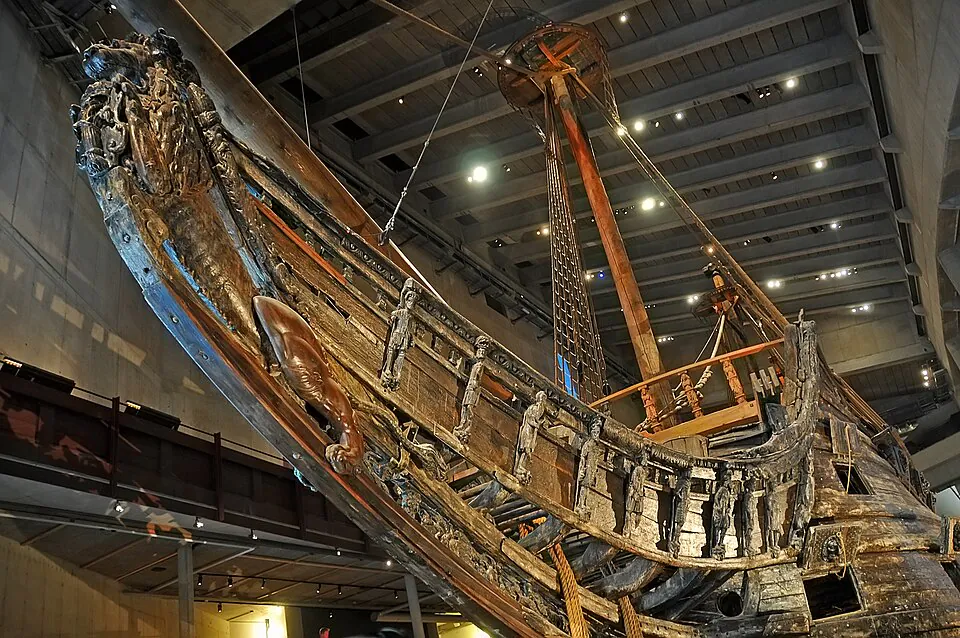
The Vasa Oak Lion Figurehead
The Swedish warship Vasa sank on her maiden voyage on August 10, 1628. She had sailed barely 1,300 meters from the Stockholm dockyard before a gust of wind caught her open gunports. She rolled over and went down in full view of the assembled launch crowd. King Gustav II Adolf had commissioned her as the flagship of his Baltic fleet. She was built too narrow and top-heavy for the amount of ballast she carried relative to the roughly 700 carved and gilded sculptures decorating her hull. This ornamental program was designed to broadcast Swedish naval power, but instead became a textbook case of a warship over-engineered for propaganda at the expense of basic stability.
This carved oak lion, roughly three meters long and weighing about two tonnes, was the ship’s figurehead. It was among the first major sculptural elements recovered once the wreck was rediscovered and salvaged in 1961, after 333 years on the seabed. Brackish, low-salinity Baltic water is inhospitable to the shipworms that would have destroyed an equivalent wreck in full-salinity ocean conditions within decades. This is the specific reason roughly 95 percent of the Vasa’s original timber survived intact enough for conservators to reassemble.
The figurehead has no market valuation. It is held, along with the rest of the reassembled ship, at the Vasa Museum in Stockholm, which has drawn more than 45 million visitors since the vessel went on public display. Its intact survival stands in direct contrast to nearly every other wooden warship element in this feature. It provides proof of how much a wreck’s specific chemical environment, as much as any human effort, determines what actually makes it back to the surface recognizable.
Underwriters, Admiralty Courts, and Sovereign Treasure

The Lutine Bell
La Lutine began as a French frigate before being captured by the British at the Siege of Toulon in 1793 and recommissioned as HMS Lutine. On October 9, 1799, she was carrying a large shipment of gold and silver bullion, insured by Lloyd’s of London, on a run to Hamburg. The money was intended to shore up a city in the middle of a financial crisis. A heavy northwesterly gale drove her onto shifting sandbanks off the Dutch island of Vlieland. Of roughly 240 people aboard, one survived. Lloyd’s paid out the full insured loss within two weeks of the sinking. That decision became a founding piece of the company’s institutional reputation for honoring even its most catastrophic claims.
Salvage attempts continued on and off for decades against constantly shifting sandbanks that repeatedly buried and re-exposed the wreck. In 1858, salvors finally recovered the ship’s bell from a tangle of chains on the seabed. Lloyd’s brought it back to hang in the underwriting room of the Royal Exchange, moving it along whenever the company relocated. It went to Leadenhall Street, and later to its current Lime Street headquarters, where it hangs today.
The bell’s real historical function had nothing to do with sentiment. It was traditionally struck once for news of a lost ship and twice for a safe return. Every underwriter with a stake in a given vessel would learn its fate simultaneously rather than through rumor. That practice stopped in 1989 after the bell developed a crack. It is now rung only for ceremonial purposes, such as royal deaths, national commemorations, and Armistice Day. The bell itself carries no market value. The 1858 estimate of £1,200,000 attaches to the original lost cargo, not the bell, and most of that gold has never been recovered.

The Mercedes 17-Ton Coin Cargo
The Spanish frigate Nuestra Señora de las Mercedes was carrying colonial silver and gold, mostly 8-reales coins minted in Lima and Potosí in 1803 and 1804. A British squadron intercepted and destroyed her off the coast of Portugal on October 5, 1804. This engagement took place before Spain and Britain had even formally declared war on each other. Over 594,000 coins, weighing roughly 17 tons combined, went down with her.
Odyssey Marine Exploration recovered the cargo in secret in May 2007 under the operation codename ‘Black Swan.’ They flew it from Gibraltar to Florida before its recovery became public knowledge. The company valued the haul at $500,000,000 during subsequent U.S. admiralty arrest proceedings. That court filing figure, not a completed sale, became the center of a five-year legal battle. U.S. courts ultimately ruled that the wreck was a sunken military vessel protected by sovereign immunity under the Sunken Military Craft Act. They ordered the entire cargo returned to Spain unconditionally in February 2012.
In this case, the $500 million appraisal and the cargo’s ultimate fate completely diverge. Descendants of merchants who had originally paid the Spanish Crown to transport commercial silver aboard the frigate also filed claims, arguing for a share of the recovery. Those claims were dismissed because the ship was on military duty at the time of sinking, which legally overrode any private commercial interest in her cargo. The coins are displayed today at Spain’s National Museum of Underwater Archaeology (ARQVA) in Cartagena. Many are still fused in solid concretion blocks that let researchers study exactly how individual mint marks and canvas coin bags had settled inside the hold before the ship went down.
“A sunken object does not accumulate value the way an heirloom does, by sitting quietly in a family’s hands. It accumulates evidence — of a disaster, a recovery, and everyone who had to decide, afterward, what the thing was actually worth.”
What the Price Tag Doesn’t Tell You
Line up the twenty figures in this feature and the range looks almost absurd. A $32 million institutional buyout sits next to a bell whose museum owners insist has no price at all. This sits next to a $500 million court filing for coins that were never actually sold to anyone. That spread is not a reporting inconsistency. It is the honest shape of how recovered maritime property actually gets valued, across at least four entirely different systems. Commercial auction, court-ordered admiralty appraisal, insurance indemnity, and outright legal inalienability rarely produce comparable numbers even when the objects themselves are comparably significant.
What determines which category an object falls into has surprisingly little to do with its age, rarity, or craftsmanship. It has a great deal to do with jurisdiction, ownership law, and who got to the wreck first. A Roman-era Greek bronze and a 1912 pocket watch can be separated by two thousand years and still land in the same legal bucket — private property, openly salable. Meanwhile, two statues found on the same afternoon, a few feet apart, can be permanently locked into national patrimony with no market value at all simply because they surfaced within Italian rather than international waters. Provenance, in other words, is doing more work in this list than material value ever could on its own.
The objects that carry no price — the Antikythera Mechanism, the Riace Bronzes, the Girona jewelry, the Whydah bell held as evidence rather than treasure — are not undervalued by comparison to the auctioned watches. They are simply operating under a different premise about what an object is for. A watch that sold for £1.78 million can, in principle, be resold again. A bronze statue held as inalienable state patrimony cannot, by design, ever repeat that transaction, because the entire point of the classification is to remove it permanently from the market it might otherwise have entered. Both are, in their own way, a society deciding what a recovered object is owed.
Sources & Further Reading
Grouped by object cluster. Auction and court figures are drawn from the citing institution’s own published records where available.
RMS Titanic & the Big Piece
- Henry Aldridge & Son, auction sale results for the Isidor Straus and John Jacob Astor IV pocket watches (2024).
- Nova Scotia Archives, CS Mackay-Bennett coroner’s body-recovery ledger, April 1912.
- RMS Titanic, Inc., SEC corporate filings on hull-section salvage and conservation expenditure.
Classical Bronzes & the Antikythera Wreck
- European Court of Human Rights, J. Paul Getty Trust and Others v. Italy (Application no. 35271/19, May 2, 2024).
- National Archaeological Museum of Athens, collection records for the Antikythera Mechanism, Antikythera Ephebe, Marathon Boy, and Artemision Bronze.
- Soprintendenza Archeologia della Calabria / Museo Nazionale della Magna Grecia, technical reports on the Riace Bronzes.
The Belitung, Girona, and Spanish Frigate Wrecks
- Asian Civilisations Museum / National Heritage Board of Singapore, Tang Shipwreck collection records (roots.gov.sg).
- Regina Krahl, “Tang Blue-and-White,” Smithsonian Institution research archive on the Belitung wreck.
- Ulster Museum, National Museums NI, Armada gallery collection records for the wreck of the Girona (Robert Stenuit excavation, 1967–1969).
- US Court of Appeals for the 11th Circuit, Odyssey Marine Exploration, Inc. v. Unidentified Shipwrecked Vessel, 657 F.3d 1159; Museo Nacional de Arqueología Subacuática (ARQVA) records.
Mary Rose, Vasa, and the Lutine Bell
- Mary Rose Trust, Portsmouth Historic Dockyard, collection and salvage records.
- Vasa Museum, Stockholm, salvage and conservation history (1961 recovery).
- Lloyd’s of London, institutional history of HMS Lutine and the Lutine Bell.
- Whydah Pirate Museum / Historic Shipwrecks Inc., recovery records for the Whydah Gally bell.
Frequently Asked Questions
A few questions this feature raises that are worth answering directly.
What makes a shipwreck artifact valuable?
Three things generally compound each other: rarity of the object type, a well-documented chain of provenance connecting the object to a specific ship, sinking, and recovery, and a completed sale or court valuation for objects that reach the open market. Objects lacking a documented recovery story, even if genuinely old, are usually worth far less than ones with a verifiable wreck history attached.
What is the most expensive shipwreck artifact ever sold at auction?
Among the objects in this feature, Isidor Straus’s gold pocket watch holds the current auction record for Titanic memorabilia specifically, at £1,780,000 (Henry Aldridge & Son, November 2024). Figures often cited as higher, such as the $500 million Mercedes coin valuation or the €300 million Riace Bronzes indemnity, are court or insurance valuations rather than completed market sales.
How are recovered shipwreck artifacts authenticated?
Methods vary by object type. Metallurgical or clay-core sampling can trace a bronze statue’s casting origin. Inscriptions like the one on the Whydah bell can directly confirm a wreck’s identity. Documented custody chains, including coroner’s ledgers, auction house provenance research, and admiralty court records, establish an object’s path from recovery to the present day.
Can shipwreck artifacts legally be sold?
It depends entirely on jurisdiction and the wreck’s legal status. Objects recovered as private salvage from vessels without a surviving sovereign claimant, like several Titanic relics in this feature, can generally be sold. Objects recovered from vessels that remain state property are typically inalienable. Sunken military craft, or antiquities claimed under a nation’s cultural patrimony laws, cannot legally enter the commercial market, regardless of who physically recovers them.
Why are some shipwreck artifacts never assigned a market price?
Many nations classify significant antiquities and sunken military property as extra commercium — legally outside commerce — specifically to prevent their sale and dispersal. Objects in this category, including the Antikythera Mechanism, the Riace Bronzes, and the Girona jewelry, may still carry an insurance or indemnity valuation for exhibition-loan purposes. However, that figure is not the same as a market price, since the object is not actually for sale at any amount.

